

What Is Moving Energy Markets Right Now
The geopolitical situation in the Middle East: this is and has been for months the key market mover, with prices for gas plus oil and its derivatives fluctuating in response to the evolution of U.S.-Iran talks and the amount of tonnage through the Hormuz Strait. As Middle Eastern oil exporters have increased efforts to bypass the Strait, attacks by Iranian proxies on Saudi Arabian energy infrastructure have come increasingly to the fore over the past month. The country was forced to suspend its key east-west pipeline in September after a drone attack by Iraqi militants, while Yemen’s Houthis have stepped up attacks on the kingdom in recent days.
Reserve releases: with Middle Eastern energy output still subdued, other countries have drawn down reserves to dampen prices in past months, with the U.S. Strategic Petroleum Reserve slumping from a little over 400 million barrels when the Iran war started to just above 280 million in early October. The extent to which this draw-down can continue and at what rate will have an important bearing on crude prices ahead.
Weather: warm temperatures in Asia in the last few months, linked to the El Niño climate phenomenon, have spurred cooling demand and demand for thermal coal in turn. And with winter to kick in soon in Europe, the depth to which temperatures fall on the continent will have an important bearing on demand for heating, and therefore natural gas.
Russia-Ukraine: Donald Trump recently announced an “energy ceasefire” between the two warring nations, as well as a deal to lift sanctions on Russian diesel exports. Whether such a ceasefire comes to pass is still in doubt, but it would likely put downward pressure on the price of fuel, as would a rise in Russian diesel exports.
Chinese imports: china is the world’s largest importer of coal, gas and oil, and as such, the country has a major bearing on the market. For instance, after the Iran war broke out in February this year, a fall in Chinese crude imports helped soften the upward trajectory of oil prices. Chinese imports fluctuate in response to the country’s domestic production levels, broader economic activity and state directives to build stockpiles.
Commodity by Commodity: Where Energy Prices Are Heading
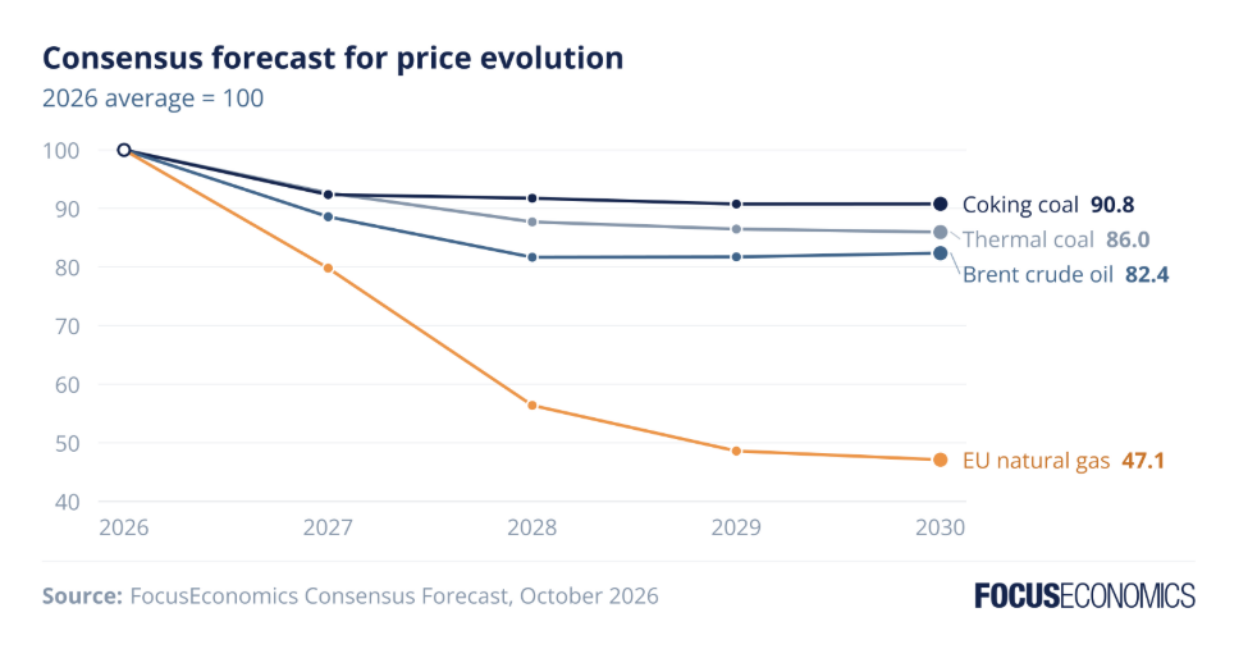
Oil: Our Brent crude oil price forecast has the commodity trending down through Q4 2027; Gulf oil production should recover as trade disruptions in the Red Sea and Strait of Hormuz lessen. Still, Brent prices will remain higher than prewar levels even in Q4 2027 as stockpiles will take time to be replenished; hundreds of millions of barrels of oil from inventories globally have been released since March. Brent prices are set to decline further in 2028, before broadly stabilizing for the rest of the decade, as oil inventories recover from their recent lows, production continues to increase in the U.S. and the Gulf, and demand growth slows amid a pivot towards less-polluting fuel.
European Gas: Prices for EU natural gas are set to fall over our forecast horizon by the most among the energy commodities we track, following the largest jump in 2026 to date. LNG exports from the Middle East should pick up as the Hormuz Strait crisis resolves, and shipments from the U.S. are set to reach record highs. Moreover, the continent’s shift towards renewables will gradually lessen its gas dependence. However, still relatively constrained Middle Eastern supplies and an EU ban on LNG imports from Russia will keep prices above levels seen before the Iran war at least until Q2 2028.
Thermal Coal: Australian thermal coal prices are projected by our panel to trend down through late 2027 as Chinese coal output recovers from mine closures and the cost of oil and LNG eases. Still, prices will remain above the post-pandemic nadir reached in Q2 2025, with oil and LNG costs to stay fairly high and a strong El Niño set to stoke cooling demand in Asia as well as hitting hydropower generation. The Iran war has led our panel to up its thermal coal price forecast in 2028–2030. Nonetheless, prices are still seen declining as less polluting energy sources gain favor; despite U.S. efforts to promote the use of coal, businesses will switch to gas and renewable energy plants.
Coking Coal: Our panel projects Australian coking coal prices to fall through early 2028. On the demand side, Chinese imports of coking coal are set to fall around a further 8% next year, according to the Australian government, as domestic coal output improves, steel output slows and steelmakers switch to coking-coal-light electric arc furnaces. On the supply side, Australian exports are set to pick up in 2027.
Where the Panel Agrees and Where It Splits
Panelists tend to agree that fossil fuel prices will trend down over the rest of the decade. However, there is a large discrepancy among minimum and maximum panelists’ forecasts, particularly for gas. The maximum 2027 price projection for EU natural gas is more than double the minimum, versus a difference of around 50% for oil and the coals. This discrepancy plays out when looking at the variation across entire panels too, as the chart below shows.
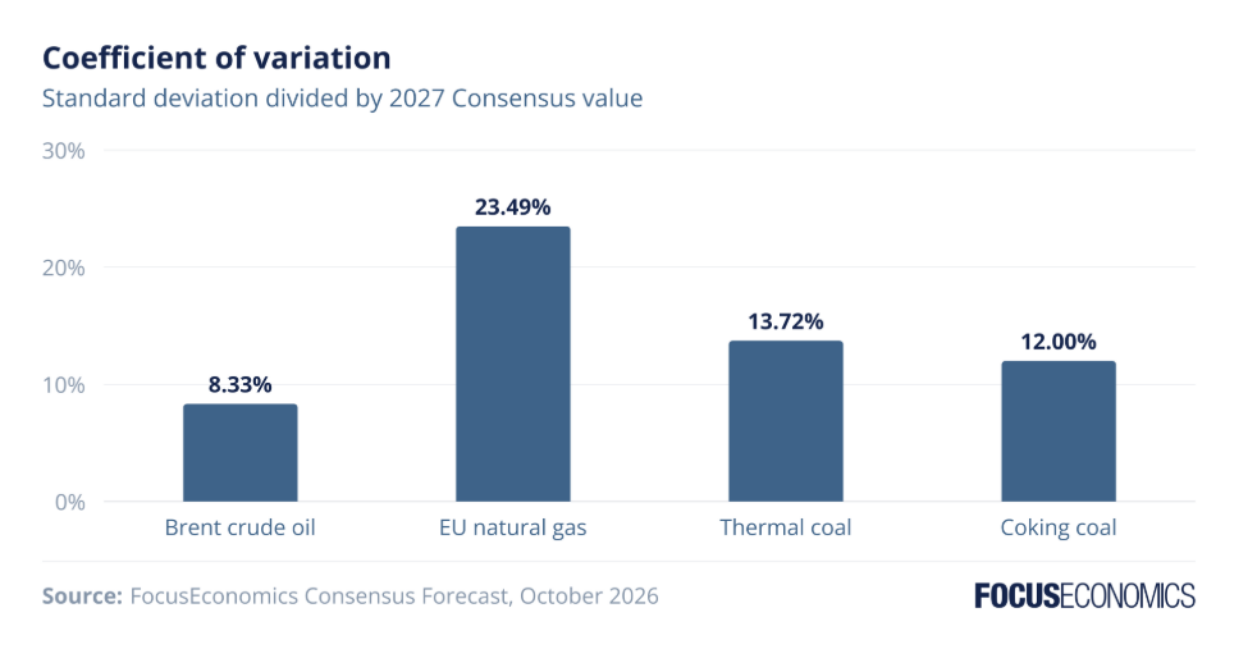
The notably higher variation in EU natural gas price forecasts relative to forecasts for oil and coal is likely linked to several factors, including the impact of the weather on heating and cooling demand; the uncertain evolution of the Russia-Ukraine conflict and its impact on the continent’s gas market; Asia competing with Europe for gas cargos; currently low European storage inventories; and a lack of strategic global stockpiles to buffer the market.
Insight from our panelists
On Iran, EIU analysts said: “Our central baseline scenario for the Iran war, prolonged stalemate, to which we assign a 50% probability, assumes that diplomacy and military action will proceed in parallel. Rather than reaching a comprehensive peace agreement or intensifying their hostilities into a broader regional war, the US and Iran will remain locked in a prolonged cycle of military flare-ups, economic pressure and intermittent negotiations until 2027. We assign a 25% probability to an advancement in negotiations (in which case the price of Brent would average US$86.4/b in 2026), and another 25% probability to a renewed military escalation (with the price of Brent averaging US$102.1/b in 2026). The current period of elevated prices and supply insecurity is weighing on global oil consumption. We forecast that global demand will contract by about 1.8m b/d in 2026, to 102.3m b/d, marking the first annual decline since the covid-19 pandemic as high fuel costs reduce transport demand and weaker economic growth dampens industrial activity.”
On gas, Goldman Sachs analysts said:
“Increased attacks on Middle East shipping have taken European natural gas prices back to the highest level seen in 3 weeks and ~20% off the local lows at the end of September. GS trading desk remains constructive on European gas given reduced Middle East LNG supply, upcoming winter weather risk and against a backdrop of seasonally low European inventory. Weather forecasts, although still early, are clearly the focus for the market and do not currently show any meaningful deviation from normal.”
How a Consensus Forecast is built: We continuously collect forecasts from hundreds of institutions worldwide, including leading banks, public agencies and private consulting firms. Our in-house team of economists and data analysts carefully reviews each forecast to ensure its accuracy, reliability and timeliness. Once the forecasts have passed our rigorous quality control process, we calculate their arithmetic mean for each indicator, producing a single, reliable figure: the Consensus Forecast.