

Housing crisis sparks protests across Iberia: The Iberian Peninsula is being rocked by protests over the housing crisis, with activists setting up camps in central squares from Madrid to Porto. The latest wave of unrest began in Spain after the eviction of an 87-year-old tenant on 23 September sparked a protest camp in Madrid’s Puerta del Sol square, with protests and similar camps quickly spreading nationwide. Portuguese activists, who have been protesting the housing crisis since March, followed suit, setting up similar camps in Porto and Lisbon.
House price growth hit multi-year highs in 2025: Portugal’s nominal house price growth averaged 17.5% in 2025, the highest since records began in 2009 and the fastest in the euro area. In neighboring Spain, house prices rose 12.7%, the fastest pace since 2006 and among the fastest in the euro area. In both countries, soaring prices are the result of demand far outpacing supply, with supply shortages accumulating since the 2008 financial crisis. Population growth, short-term tourist rentals, strong labor markets and the arrival of high-income foreign residents have driven significant demand for housing, while mortgage guarantee schemes for young people and falling ECB interest rates between mid-2024 and mid-2025 further supported homebuying. Meanwhile, construction failed to keep up with rising demand. Persistent labor shortages plus lengthy licensing and construction bureaucracy haven’t allowed homebuilding in either country to recover to pre-financial-crisis levels.
One crisis, two policy responses: The two governments’ responses to the crisis have diverged starkly. Spain’s left-wing government has pursued stronger tenant protection, rent regulation, restrictions on the non-residential use of housing and a larger public stock. Meanwhile, Portugal pursued a broadly similar regulatory approach until a center-right government took office in 2024. Since then, policy has pivoted toward supply stimulation measures, including land liberalization, simplified planning and tax incentives. The legal uncertainty and frequent policy changes in both markets have likely weighed on commercial residential building.
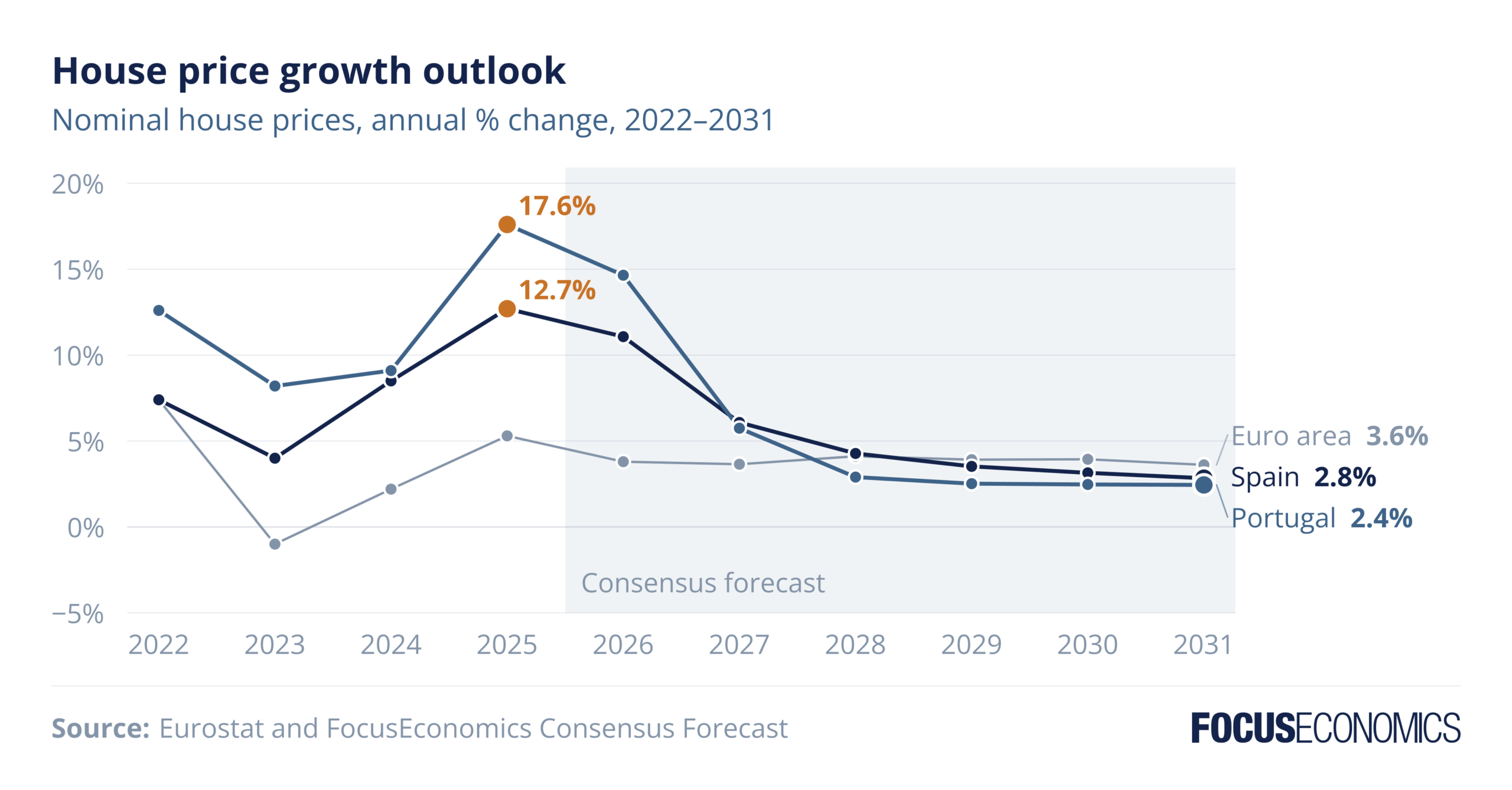
Our Consensus Forecast suggests house price growth peaked in 2025: Portugal’s house prices continued to surge at the fastest rate in the euro area through Q2 2026, while growth in Spain also remained strong. Nevertheless, our panelists see house price growth as having peaked in both countries in 2025 and expect it to slow somewhat in 2026 while remaining in double digits. Tighter ECB monetary policy and rising inflation amid the Iran war should cool homebuying demand somewhat. Looking ahead, our Consensus shows house price growth in both countries slowing through the end of our forecast horizon in 2031 and falling below the euro area average from 2028 onwards. In Spain, a potential coalition between the conservative PP and far-right Vox after the 29 November snap election could lead to a greater emphasis on supply-side housing policies and looser rental restrictions, broadly resembling Portugal’s 2024 policy shift. However, in both countries, the projected slowdown in house price growth will still reflect decelerating demand rather than easing supply shortages, given that the latter will take time to fix.
Insight from our panellists:
Analysts at Portugal’s Banco BPI commented on this year’s expected house price slowdown:
“Factors supporting robust price gains in 2026 include labor market strength, limited supply of new properties and construction cost pressures. On the other hand, the growing decoupling between house prices and wages alongside rising interest rates tends to moderate appreciation compared to 2025.”
They also elaborated on the drivers behind the expected house price deceleration in Portugal:
“New mortgage lending showed impressive strength in H1, but the introduction of new limits in macroprudential rules should cool this momentum. […] It is estimated that [the 45% debt service-to-income cap] could cool new lending, particularly regarding the state guarantee for young buyers.”
ING economist Pablo Muylle commented on the outlook for Spain:
“Protection primarily determines how an existing shortage is distributed. It cannot, on its own, increase the number of homes. […] Spain needs additional ready-to-build land, faster and more predictable planning, sufficient infrastructure and construction capacity, and a much larger stock of social and affordable rental housing. Even then, the results will be slow. Closing the accumulated gap would require several times the current level of completions.
No government elected in November can close such a gap within one term. […] Spain’s next government should therefore be judged on two outcomes: how much tenants pay and how many people can find a home at all.”