

On 25 October, President Luiz Inácio Lula da Silva pulled off the comeback of his career, beating Senator Flávio Bolsonaro in the runoff to secure an unprecedented fourth term. Markets, which had bet heavily on a Bolsonaro victory after his first-round lead, were caught wrong-footed. So what does Lula 4.0 mean for Latin America’s largest economy?
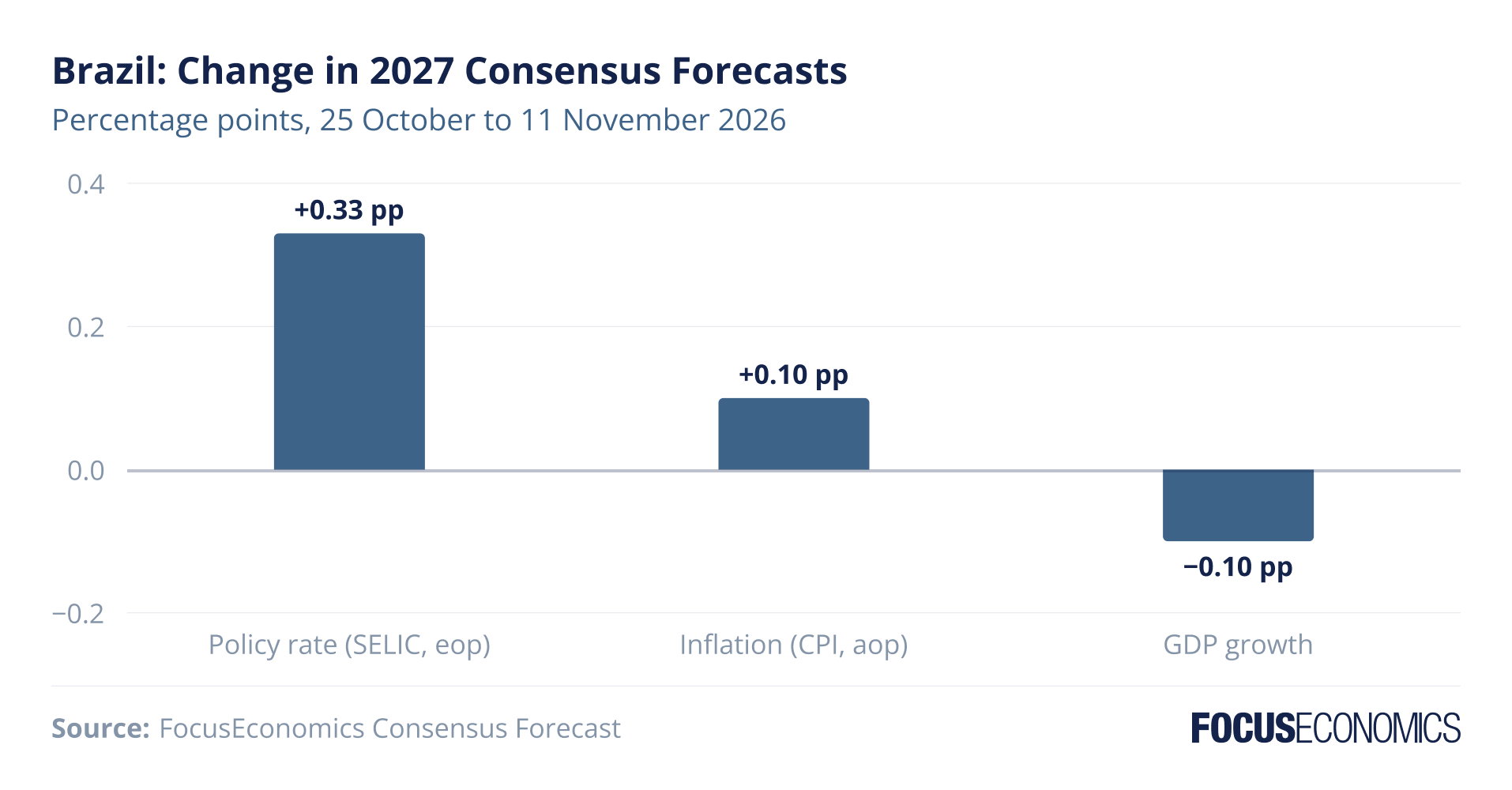
Inflation and interest rate forecasts revised up: Investors had viewed a Bolsonaro administration as more likely to rein in public spending, so Lula’s win forced a rapid repricing of fiscal risk. As a result, from the eve of the runoff to 10 November, the real lost around 10% of its value against the U.S. dollar. The weaker currency, together with likely softer fiscal consolidation under Lula than Bolsonaro, explains the upward revisions to panelists’ inflation and interest rate projections. The Central Bank already tapped the brakes on its easing cycle on 4 November, holding the SELIC rate at 13.75% after five straight cuts, and its minutes signaled that policy would stay tight for longer amid drifting inflation expectations.
GDP growth outlook worsens: The downgrade to our Consensus for 2027 economic growth was underpinned by higher forecasts for inflation and interest rates, coupled with greater investor jitters over public spending reining in business investment. Our panelists expect GDP growth to be the weakest since the pandemic in 2027 amid the fading of election-year fiscal stimulus, and to trend at an uninspiring 2% for the rest of Lula’s fourth term—far too slow for convergence with developed-economy living standards.
Fiscal policy will be key: Gross public debt rose by over 10 percentage points during Lula’s third term, and the budget deficit is running at over 8% of GDP—unsustainable by any metric. The government recently sent Congress a package to modestly tighten its fiscal rules—including a mechanism to cap real spending growth at a lower level. However, panelists are pessimistic on Lula’s ability to get the fiscal house in order: Our Consensus is for the budget shortfall to remain one of the world’s largest in coming years due to elevated mandatory spending, a lack of political consensus for deep reform and Lula’s ideological aversion to deep spending cuts. The risk is that market confidence in the government’s fiscal management dries up entirely, causing the real to tank further and bond yields to spike. In that sense, markets’ post-election angst may just be a taste of things to come.
Insight from our panelists:
On fiscal policy, EIU analysts commented: “We believe that the Lula administration will maintain an expansionary fiscal policy in the 2027-30 term, relying on one-off revenue-raising measures to keep the deficit from widening excessively. The next Congress will lean further to the right, so it is likely to be more willing to curb Lula’s spending urges. Mandatory outlays absorb more than 90% of federal primary spending, and powerful interest groups, notably public-sector workers, have long resisted cuts to their pay and benefits, limiting room for spending cuts. We expect the fiscal deficit to average 7.3% of GDP annually in 2027-30, whereas the primary deficit will average 0.7% of GDP in the same period. We are pencilling in fiscal consolidation only from 2031, assuming that the following administration adopts a more conservative policy.”
Goldman Sachs analysts said: “We would expect, at most, modest measures to contain primary spending growth, alongside further increases in an already high tax burden. The administration would likely retain its strong belief that the public sector and state-owned enterprises should remain central engines of growth and investment. Major structural reforms would be unlikely. […] Deep social and political polarization will make it especially difficult to build and sustain broad, effective coalitions in Congress. Bridging this entrenched divide would be a major, though unlikely, achievement.”
Commenting on their forecast revisions, Itaú Unibanco analysts said: “For 2027, we have also cut our GDP growth forecast to 0.5% (from 1.2%), in light of tighter monetary conditions, compounded by greater inflationary pressure and high household and corporate indebtedness. […] We have revised our exchange rate forecast to BRL/USD 5.40 in 2026 and BRL/USD 5.60 in 2027 (from BRL/USD 5.30 and BRL/USD 5.50, respectively). The revision reflects the increase in the domestic risk premium amid greater uncertainty over the path of public accounts and the outlook for fiscal adjustment in the coming years.”