GDP growth under Trump
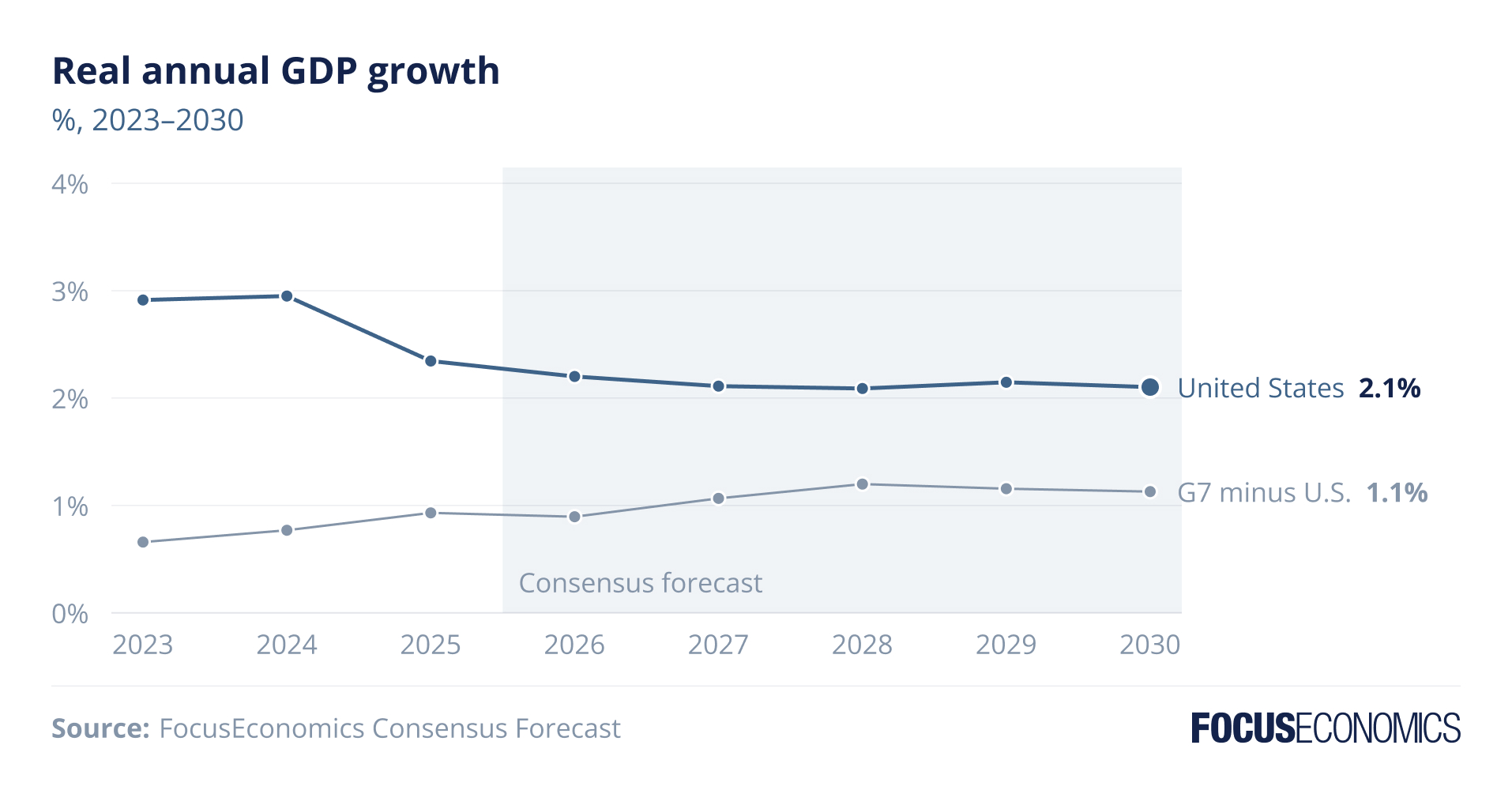
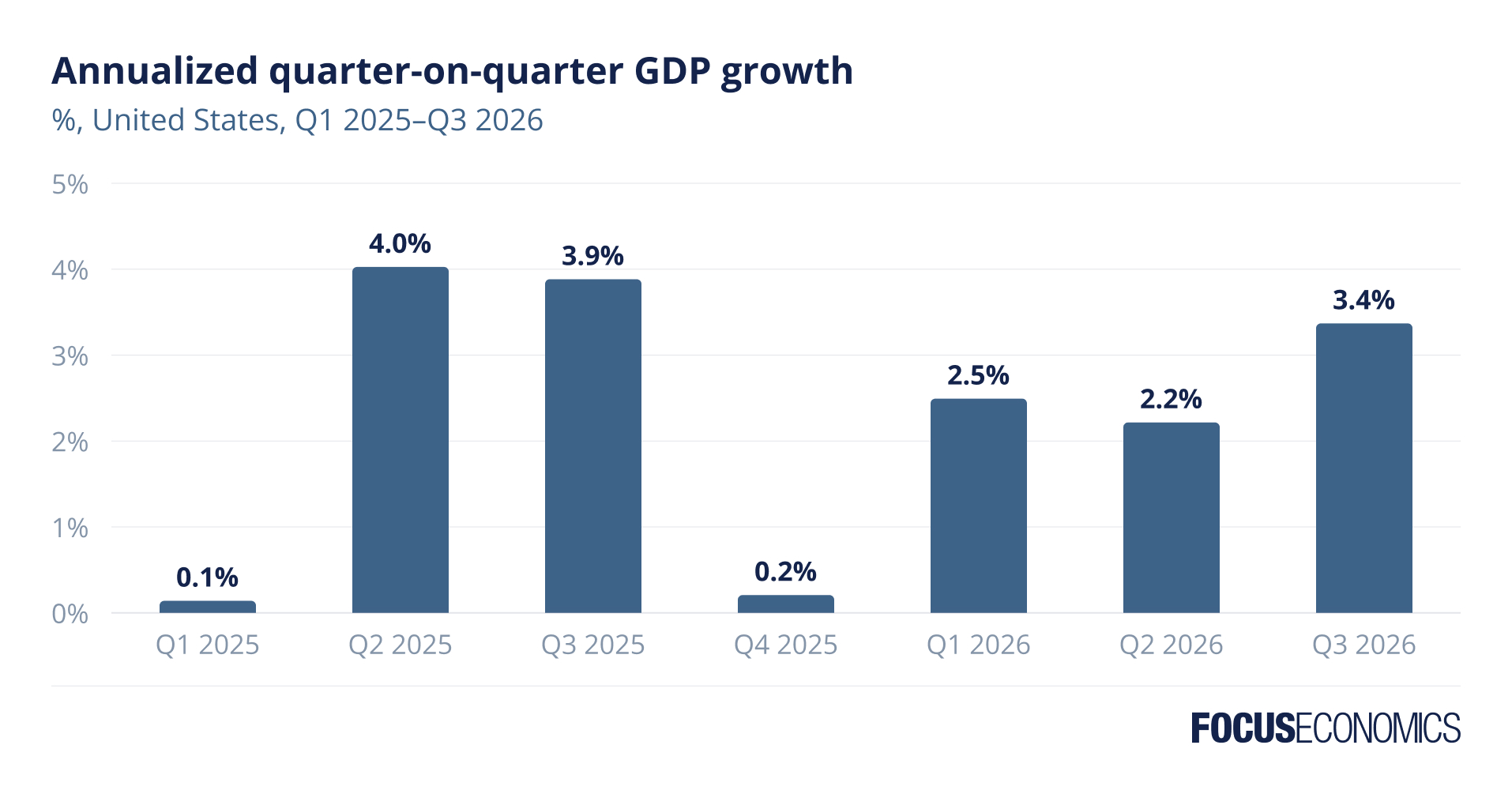
U.S. GDP growth has tended to outperform the rest of the G7 since Trump’s return to office. Swings in net trade as firms navigated the administration’s changing tariff regime caused temporary slowdowns in Q4 2025 and Q1 2026, with Q4’s loss of speed amplified by the recordlong government shutdown.
That said, U.S. outperformance is likely in spite of government policy, not because of it; tariffs have hurt trade, and the war in Iran has buoyed inflation and interest rates while damaging consumer sentiment. Massive tech investment linked to the AI boom coupled with resilient household spending has been key to the economy’s continued success.
Inflation under Trump
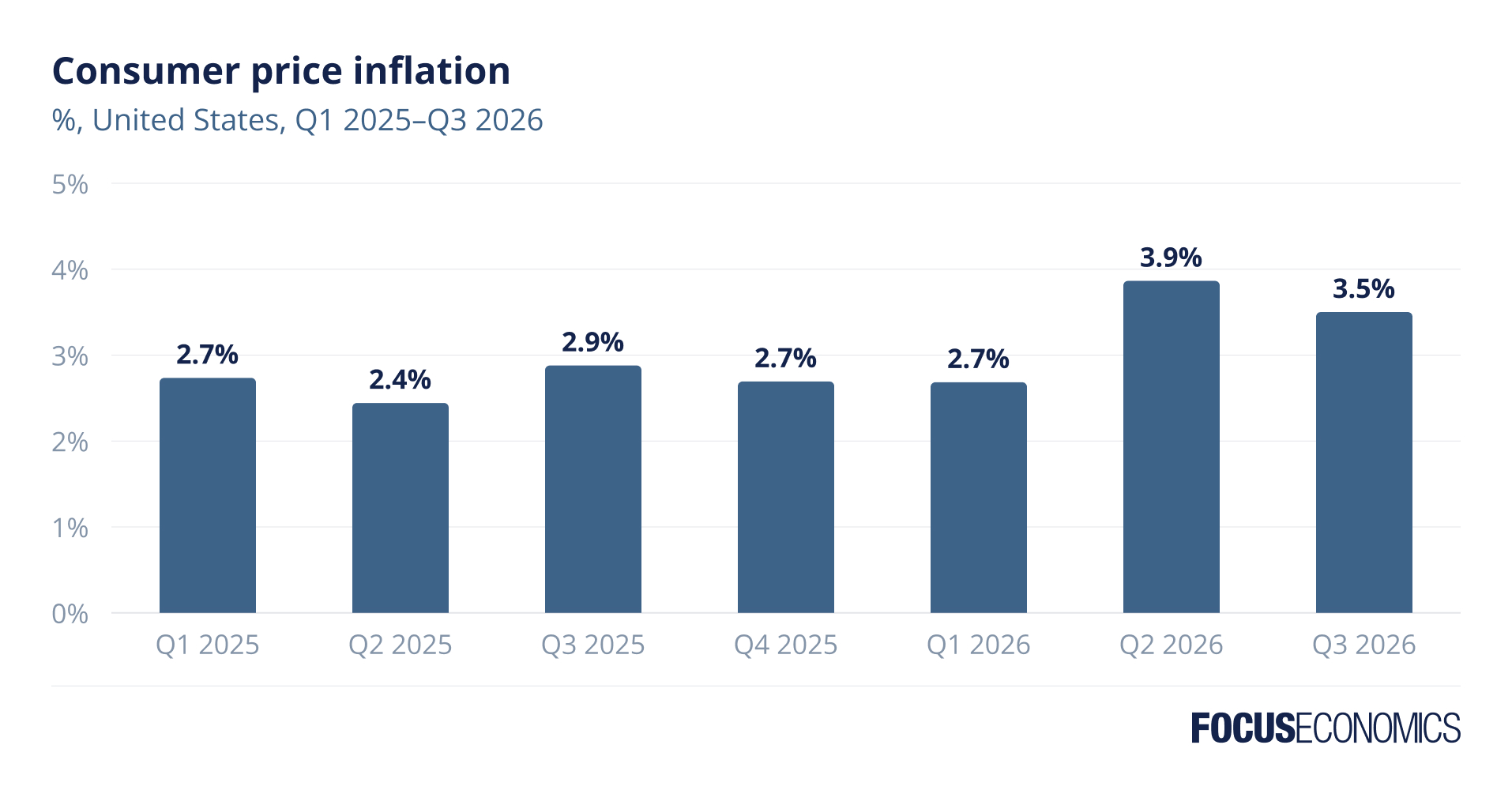
One of the president’s key campaign promises was to bring prices down. In reality, the opposite has happened, with U.S. inflation hitting the highest since 2023. This is mainly a product of the Iran war hiking fuel costs, though the surge in demand for computer chips has raised electronics prices too.
The trade deficit
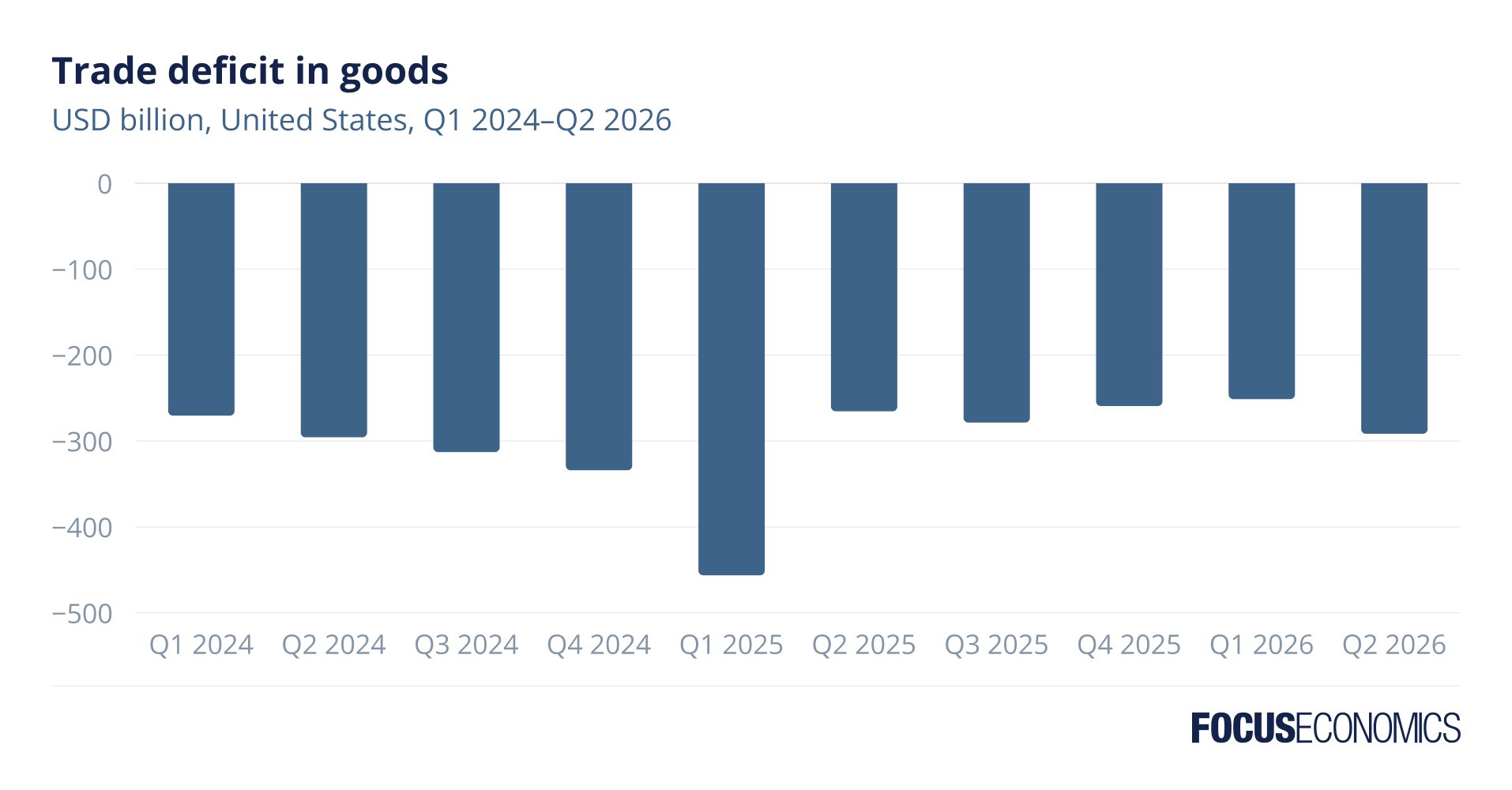
The average effective U.S. tariff rate has risen from less than 3% at the start of Trump’s second term to around 7% today. However, the negative U.S. trade balance in goods has only narrowed slightly over the same time frame, reflecting strong consumer spending, the lack of ready-made domestic alternatives for many overseas goods and the fact that tariffs aren’t at high enough levels to lock out many imports entirely.
The fiscal deficit and public debt
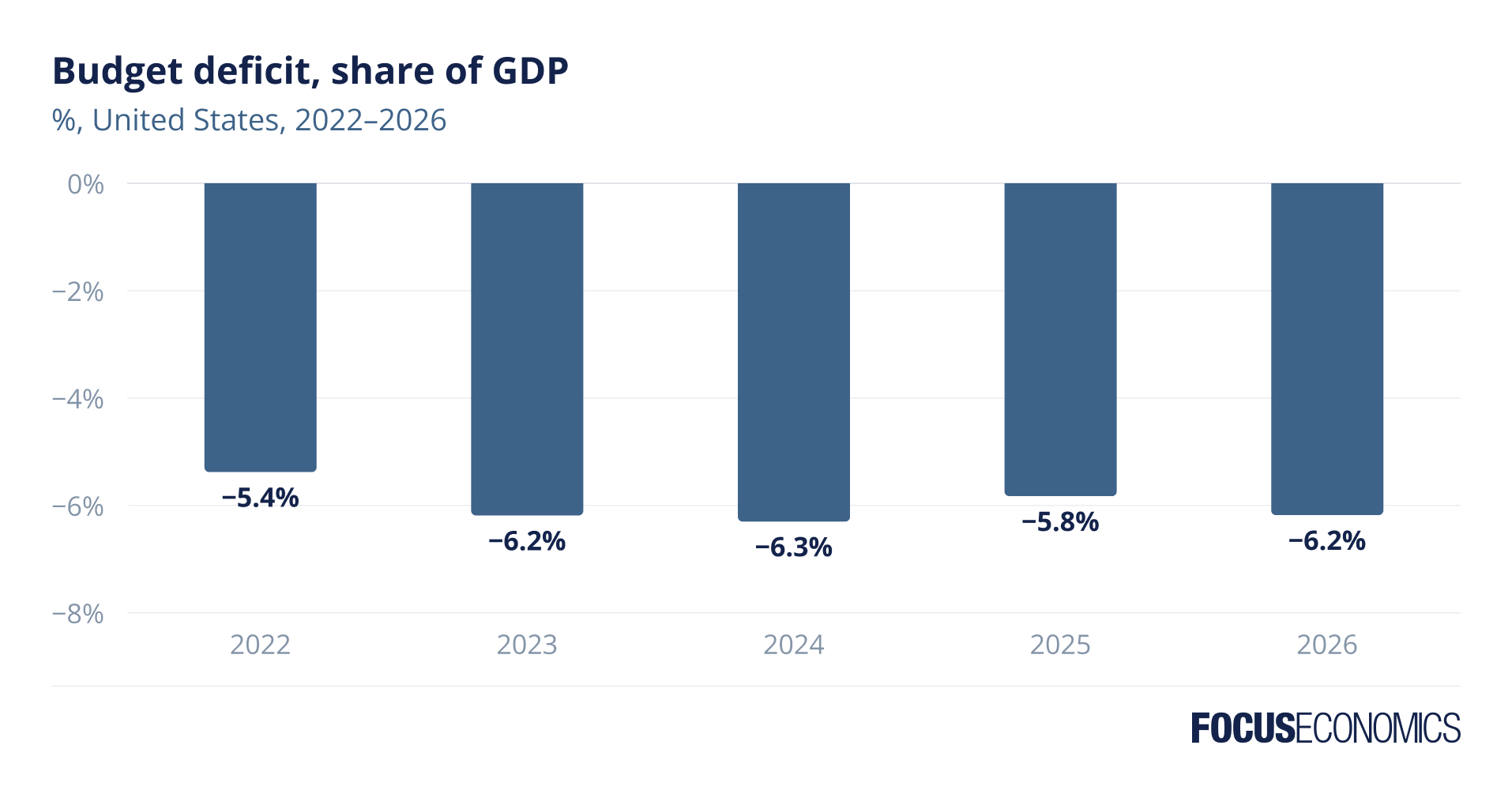
Despite Elon Musk’s Department of Government Efficiency (DOGE) being launched to great fanfare in early 2025, the fiscal deficit under Donald Trump’s administration has barely budged and remains the widest in the G7. This is due largely to elevated mandatory spending on healthcare and pensions, with 2025’s One Big Beautiful Bill Act (OBBBA) further adding to the fiscal shortfall. There are also bond yields to consider: Their recent rise has added to the government’s debt interest payments.
What the midterm results mean for the U.S. economy
Tariffs and taxes after the midterms: With Democrats sweeping to majorities in the House and Senate, the key consequence will be paralysis of the president’s domestic legislative agenda. The Democrats gain the power to block presidential legislation and launch congressional investigations, but lack the two-thirds majority in both chambers to overcome a presidential veto and advance their own agenda. The risk of another government shutdown will rise, and there is also likely to be more wrangling over the public debt ceiling, which will need to be raised sometime in 2027. Tariff policy is likely to remain dictated by executive orders from the president, at least in the short term. Likewise, Trump maintains the prerogative of whether to escalate fighting in the Middle East—with all that would mean for oil prices, domestic inflation and Federal Reserve interest rates.
Nomura analysts commented on fiscal policy: “For now, a Democratic-controlled Congress would likely lead to greater legislative gridlock over the remainder of Trump’s term, limiting the scope for major fiscal policy changes before 2029. A strong Democratic showing has improved market perceptions of the party’s prospects for securing a blue trifecta in 2028 with a probable scenario of a supermajority in the Senate. Such an outcome could shift fiscal risks toward greater spending commitments from 2029.”
That said, Goldman Sachs economists see the Democrats squeezing some policy wins fromthe president during fiscal negotiations—even in areas which Trump nominally controls: “Government funding will need to be extended, and the debt limit raised by next fall, which Democrats are likely to leverage to win policy concessions. It is not yet clear what Democrats will seek in return, but limiting the war with Iran, tariff rollbacks, the reversal of spending cuts, and expanded health benefits appear to be high on the list of priorities.”
The AI sector: The Democrat-controlled Congress will undoubtedly bring more pressure to bear on the AI industry, though it will require Trump’s agreement (or for the Democrats to ally with Republicans to secure a two-thirds congressional majority) to pass new regulations at the federal level. Political opposition to AI data center construction in state legislatures is likely to rise, given backlash against it partly explained the Democrats’ midterm gains; this could have a knock-on effect on U.S. fixed investment. Greater congressional scrutiny of AI development coupled with more state restrictions on data centers raises the risk of a bust in tech stocks—a correction some market analysts have been warning of for some time. On 5 November there were already signs of this, with the Nasdaq 100 posting its biggest daily drop since 2020.
On data centers, EIU analysts commented: “Republicans lost gubernatorial races in Texas, Ohio, Nevada, Georgia, Michigan, Pennsylvania and Arizona. With the exception of Ohio, Democratic candidates campaigned on tightening the regulation of data centres. Together, these states account for about half of planned US data centre capacity. […] We expect some additional data centre-related restrictions. This is especially likely in states where candidates pledged partial or conditional moratoriums, as in Texas, Georgia and Michigan.”
ING analysts added: “We think sweeping data centre legislation is unlikely because of President Trump’s veto power. Federal action is more likely to focus on affordability by protecting electricity customers from higher costs and formalising data centres’ responsibility to help fund grid and energy infrastructure upgrades. Such measures could be added to broader legislation, such as must-pass spending bills needed to avoid a government shutdown, or a bipartisan package like permitting reform.”
Trump’s position: The best chance of significant policy changes on tariffs, Iran and AI stems from Trump himself. The president could take heed of the Democrats’ clean congressional sweep and alter course to appease the electorate—perhaps rolling back some import levies, reaching a peace deal with Iran and pushing for more AI restrictions. He could equally do the opposite, doubling down on his current tariffs, belligerent Iran stance and laissez-faire AI policies in a bid to cement his political legacy in his final two years in office.
China policy: The U.S. will maintain a protectionist attitude toward China and likely continue efforts to reduce its reliance on the Asian nation in areas such as rare earths. As ING analysts commented: “Building more secure energy and natural resource supply chains has long attracted bipartisan support in the US. […] We expect this focus to continue. The executive branch could pursue further protective measures and is unlikely to face major opposition from Congress. Congress could also authorise additional funding to strengthen rare earth supply chains.”
Our Consensus Forecasts for the U.S. economy
For now, neither legislative gridlock nor greater AI-sector scrutiny is projected to blow the economy off course, with our Consensus Forecast for GDP to continue growing above 2% for the rest of Trump’s second term—the best result in the G7. The U.S.’ underlying strengths—a dynamic tech sector, flexible labor market, an entrepreneurial population—remain intact. Inflation is projected to peak this year and decline thereafter, with U.S. interest rates to max out in early 2027. The budget deficit will remain close to 6% of GDP, where it’s been since the pandemic—this will be both a tailwind for the economy and a rising source of financial risk. As has been the case for decades, the party in charge of Congress may change, but the U.S. economy continues to march imperviously on.