

The conflict that has been ongoing since the end of February between Iran, the U.S. and Israel has had huge economic fallout for economies in the Middle East, through multiple channels. Missile strikes have damaged infrastructure in the region. Air travel has been severely restricted. Iranian attacks on shipping in the Strait of Hormuz—a major chokepoint for global energy flows—have hit oil exports from Gulf countries, while U.S. and Israeli attacks on Iran have likely damaged Iran’s own exports of crude. Several nations have announced oil output cuts due to a lack of domestic storage capacity. Many schools have closed and employees told to work from home.
Downward revisions to GDP growth forecasts
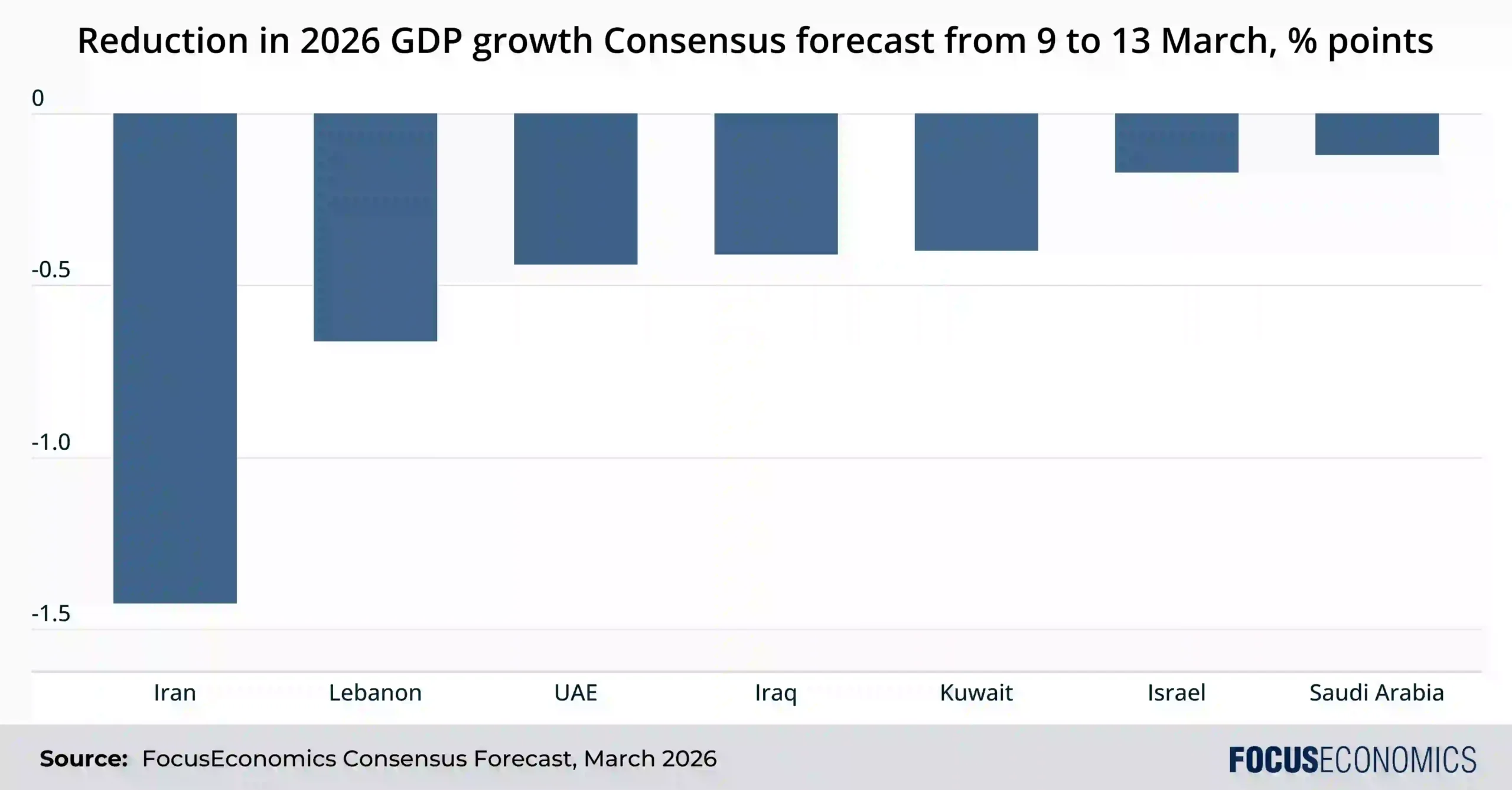
As a result, our panelists have slashed their 2026 GDP growth forecasts in recent days. The downgrades began about a week into the conflict and have been ongoing since. As the chart below shows, the largest downgrades to our Consensus have been in Iran and Lebanon, of 1.5 and 0.7 percentage points respectively between the 9th and 13th of March.
This makes sense, given these are the countries seeing the heaviest destruction from missile fire. Lebanon has been dragged into the war due to the presence of paramilitary group Hezbollah in Lebanese territory; as of mid-March there were around 800,000 displaced people inside the country, over 15% of the population. Iran’s economy was already creaking before war broke out due to Western sanctions, nationwide protests and heavy currency depreciation fanning inflation.
Impact on the Gulf economies
The UAE, Iraq and Kuwait are next in line. Despite avoiding significant missile damage, all three countries have announced oil production cuts in recent days as transit problems in the Strait of Hormuz make it impossible to ship oil. Moreover, foreign direct investment inflows are likely to take a hit.
Saudi Arabia, which is able to export most of its crude via land routes, has seen a comparatively limited GDP forecast downgrade. Israel has also only seen a small downgrade as of yet. Damage in Israel from Iranian missile strikes is fairly limited, and the economy is far more diversified than the oil-dependent Gulf nations.
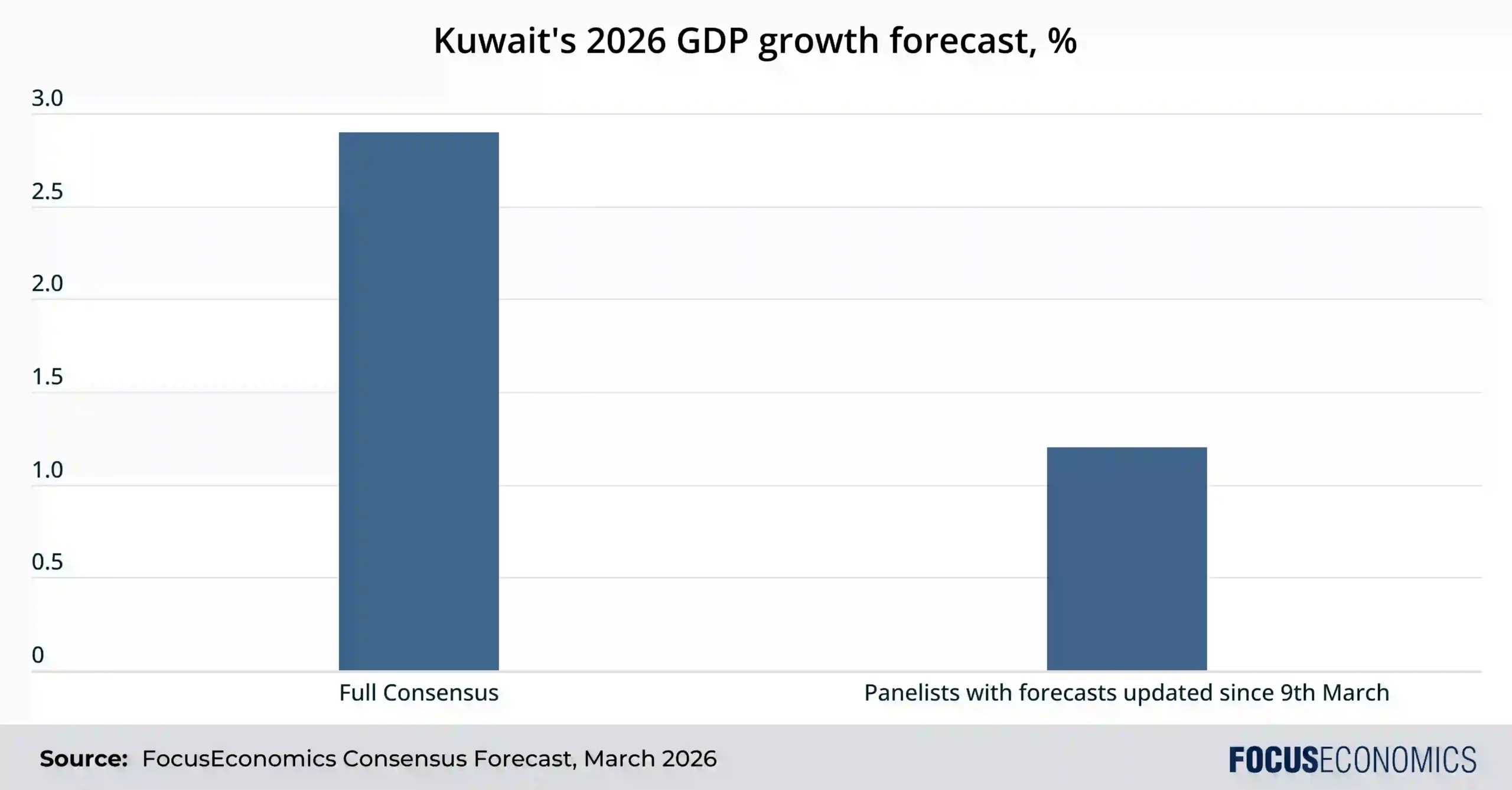
Consensus GDP projections will fall further going ahead, and looking at the most recently updated panelists gives a sense of where these projections could end up. For instance, the Consensus is currently for Kuwait’s economy to expand 2.9% this year, down from 3.3% before the conflict. However, taking into account only panelists that have updated forecasts since the 9 March, that figure drops to just 1.2%. Panelists can be filtered by date in order to create a custom consensus by subscribing to our FocusAnalytics platform.
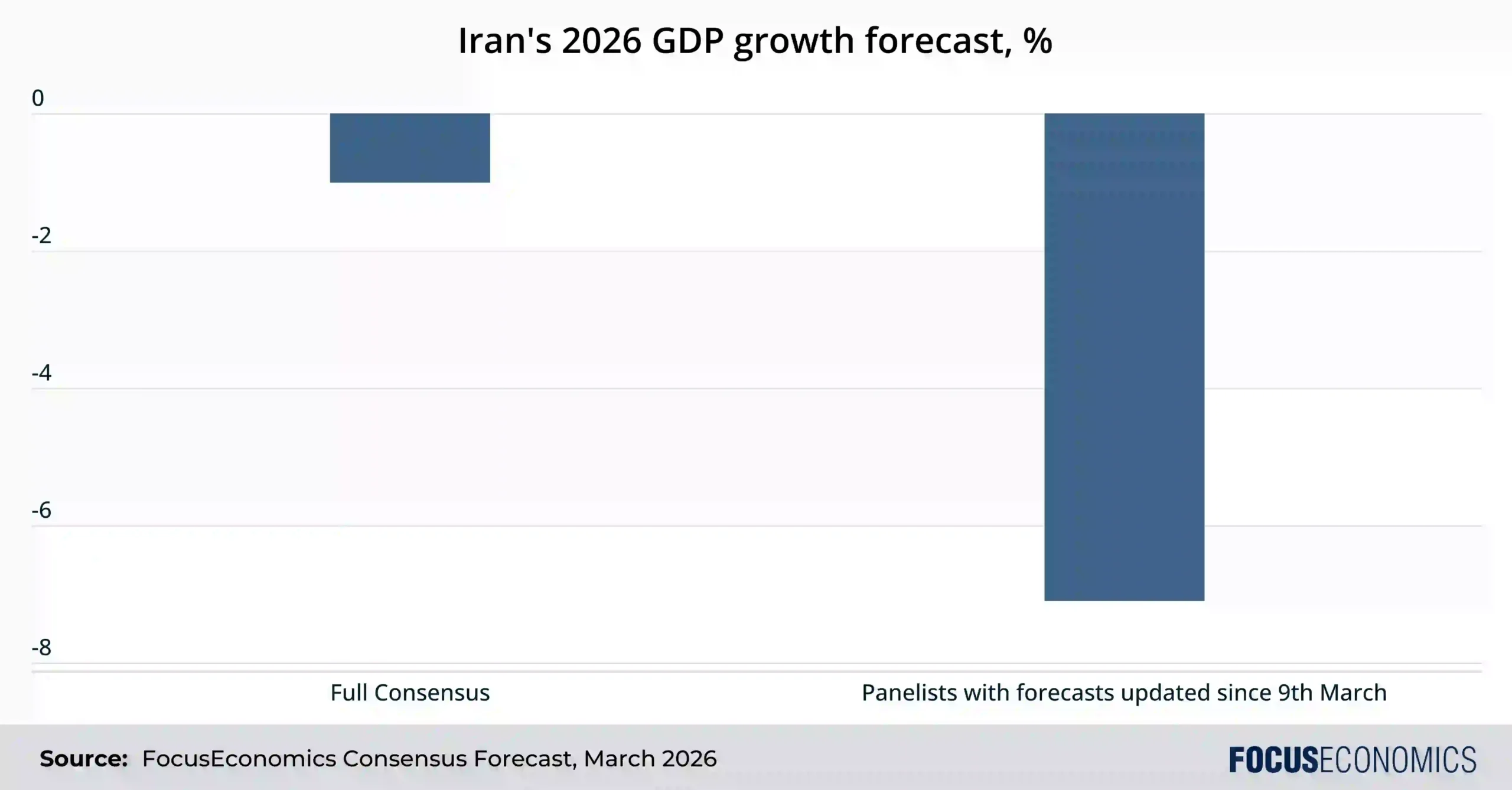
Let’s take another example. Iran’s economy is expected to contract 1.0% in 2026 according to our Consensus. However, panelists with forecasts updated since the 9th March project a much steeper fall of 7.1%.
Energy Dynamics: How Our Forecasts for Oil and Gas Are Changing
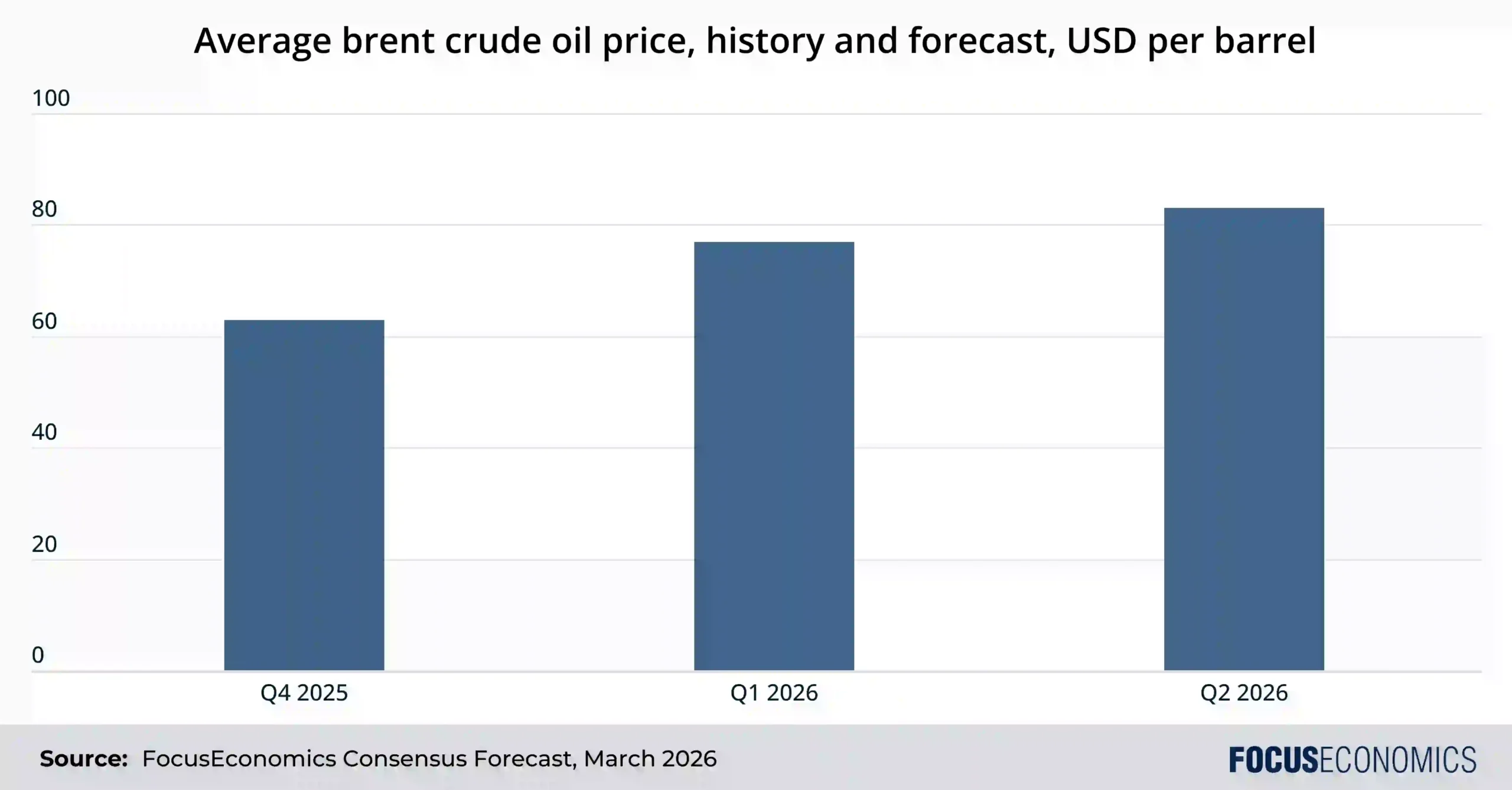
It’s a similar picture in the energy market. Among the panelists who have updated their forecasts in recent days, the Consensus is for Brent crude prices to average USD 83 per barrel in Q2 of this year. This would be lower than the current spot price but around 20% higher than last year’s average. As long as the conflict continues, the emergency release of stockpiles by the West will be unable to compensate for Gulf producers cutting output and exports being disrupted by Iranian attacks on shipping. The geopolitical risk premium is likely to remain elevated in absence of a comprehensive ceasefire that commits Iran to refraining from future shipping attacks.
Natural gas prices to rise too
The increase in European natural gas prices is projected to be even more dramatic. Our most up-to-date panelists forecast an average price in Q2 2026 of USD 18 per million British thermal unit—up 50% on the 2025 average. Qatar is one of the world’s biggest LNG exporters. All of the country’s LNG production—around a fifth of the global total—is currently offline and could take time to ramp up again, which is likely to bid up prices.
Higher prices, but less revenue
While oil prices are now above Gulf countries’ fiscal breakeven oil prices—the point at which energy prices enable a government to balance its budget—the Middle East won’t benefit. Lower energy production and an inability to export much crude will likely cause revenues to fall in the region as a whole despite sky-high prices.
Many Gulf nations have substantial sovereign wealth funds with which to soften the blow of temporarily lower revenues. Those that don’t, such as Iraq, are in trouble. Iraq’s vulnerabilities are compounded by its extreme oil dependence and the presence of both U.S. assets and Iranian-linked paramilitary forces on its soil, which raises the risk of the country being caught in the military crossfire.
The Bottom Line: Our Updated Forecasts for 2026
Our Consensus forecasts for economies in the Middle East will continue to be slashed and the Consensus for oil and gas prices will continue to rise in coming weeks, with every panelist adjustment visible in real time via our FocusAnalytics platform. Only an end to hostilities will stop these forecast revisions. When that end will come is anyone’s guess.