

Exports soar: In our latest special PDF report, we examined the economic panorama for key East Asian economies amid the AI boom. One key takeaway is that chip producers such as China, Malaysia, Singapore, South Korea and Taiwan have seen exports skyrocket so far this year thanks to AI-related chip demand. Demand is soaring due to AI model training and inference requirements.
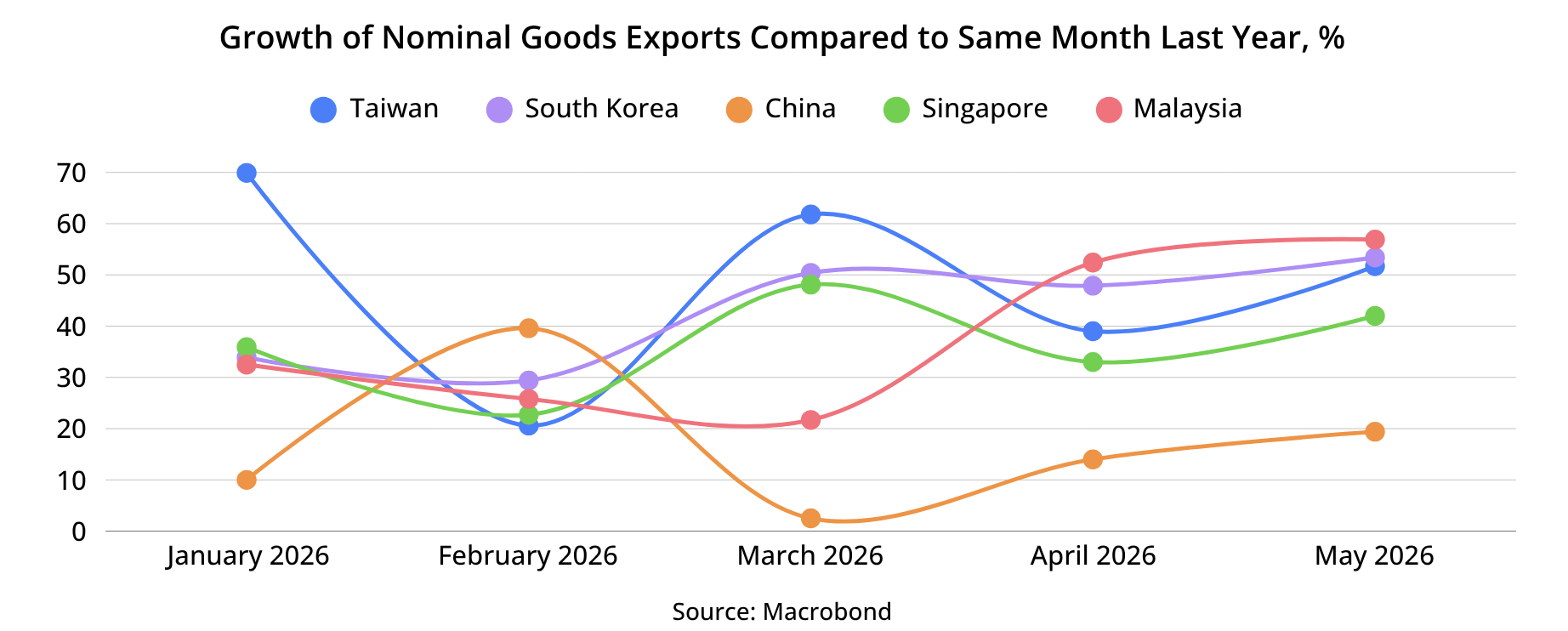
Higher volume sales and prices at play: The export boom has been partly due to higher volumes, as manufacturing growth readings (calculated in constant prices) indicate. However, surging prices due to tight supply have also been a major factor. For instance, the U.S. producer price index for chips rose from around 60 for most of last year to near 75 in May 2026.
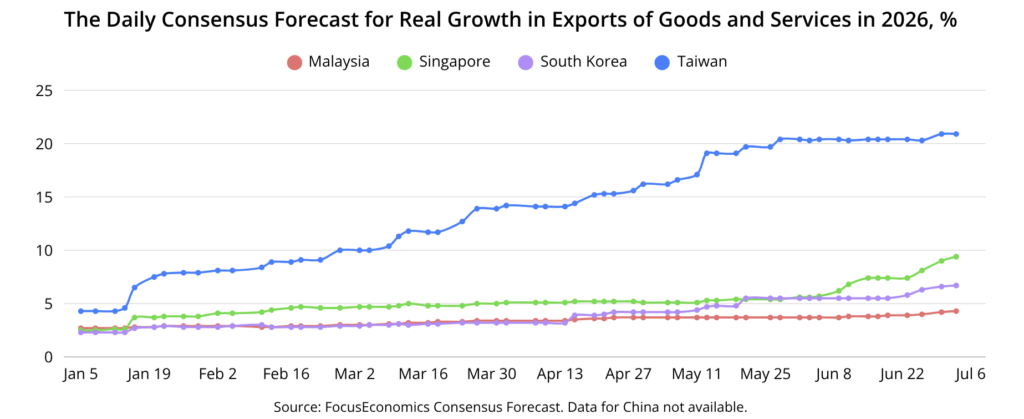
Forecasts rise in tandem: Since the start of 2026, our panelists have rerated their 2026 exports forecasts considerably in response to recent blowout data, as the chart below shows.
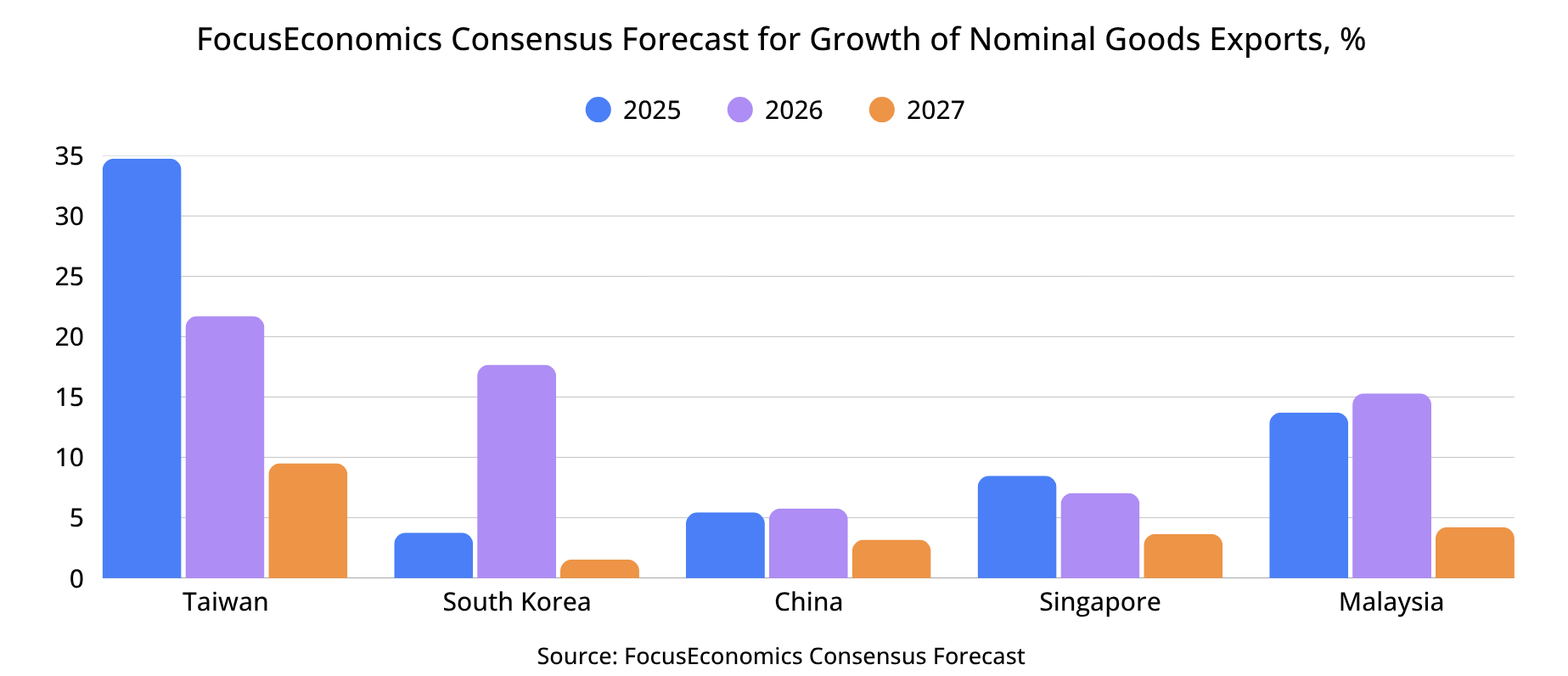
Export growth to continue: The global size of the semiconductor market is forecast to nearly double to USD 1.5 trillion this year and to reach USD 1.9 trillion in 2027, underpinned by rising adoption of AI by firms and consumers. This will feed through to higher export this year and next among key Asian economies. However, in line with the maturing chip market, export growth will be notably slower next year compared to 2026.
Insight from our panelists:
On the outlook for the chip sector, ING analysts said:
“The semiconductor outlook remains exceptionally strong. Rising demand for high-end chips, structural shortages in legacy chips, limited supply-capacity expansion, and heavy hyperscaler investment should extend and strengthen the chip cycle. More recently, China has stepped up investment in AI. Europe is accelerating efforts to build sovereign AI capabilities and reduce reliance on foreign technology. Thus, we expect AI adoption to broaden globally, extending the current semiconductor supercycle for a considerable period.”
Goldman Sachs analysts commented on how individual countries are faring:
“Between 5-10 cents of every US AI investment dollar ends up in Taiwan: about half of US AI investment is in compute, with Nvidia capturing a huge fraction of this; much of the rest finds its way to Asia, with TSMC the single biggest supplier. Korea sees about 1/4 as much revenue from overall semiconductor sales as Taiwan, with growth driven by demand for high-bandwidth memory chips; with an economy that is twice as big, its GDP boost from AI/tech investment is much more modest. Beyond the outperformance of Taiwan and Korea’s leading tech firms, competition from Chinese manufacturers is intense, limiting margins and growth.”
Our latest analysis:
Mexico’s central bank held rates in June.
Argentina’s economy lost steam in Q1.