

Q2 slowdown: GDP growth slowed to 4.3% year on year from 5.0% in the previous quarter, the weakest since Q4 2022 and below market expectations. Growth was held back by myriad factors: Subdued consumer confidence, fading support from earlier front-loaded purchases under the government’s trade-in scheme, tight fiscal policy, and persistent weakness in construction and property. Bright spots were financial services and merchandise exports—the latter benefitted from booming electric vehicle and tech sales.
Weakness continues in July: Last month, data for retail sales, industrial production, fixed investment, new loans and services output all performed worst than market analysts anticipated. Merchandise exports again stood out as an almost solitary point of optimism, rising by nearly a quarter.
Economy running at different speeds: The gloomy macroeconomic picture overall contrasts with surging activity in certain areas. EVs are one—Chinese electric car companies are world-leading, and rapidly taking market share from established players. AI and robotics are another; China’s AI model releases have come thick and fast in recent weeks, and now rival the quality of models from leading U.S. firms Anthropic and OpenAI according to independent analysis. Chinese firms in the space are listing at sky-high stock market valuations: Chip maker CXMT became mainland China’s most valuable firm after listing in July, and robotics manufacturer Unitree recently saw its IPO oversubscribed by thousands of times among retail investors. However, for now, these pockets of dynamics aren’t enough to lift the overall economy out of its funk.
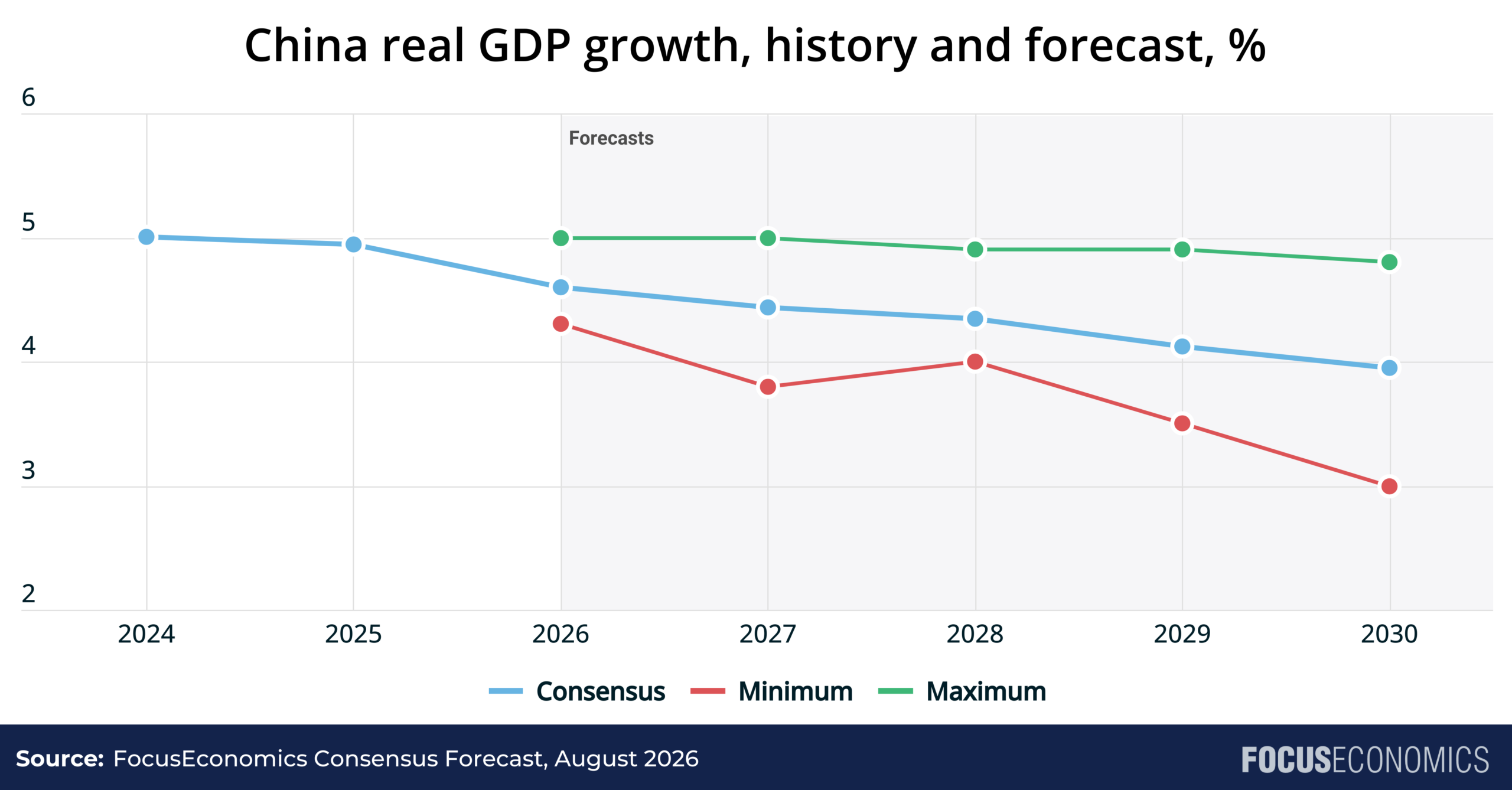
Our Consensus: The 64 analysts that comprise our China panel believe that the only way is down for economic growth in coming years, with growth projected to slip below 4% by 2030. Factors such as an increasingly quick population decline, intensifying foreign protectionism, and declining rates of return from infrastructure investment will be to blame. The government could likely boost the trend rate of growth—at least temporarily—by privatizing and liberalizing the economy as well as focusing more government resources on lifting consumer spending. However, none of these seem priorities at present, with the administration’s focus instead on ensuring social stability and securing a dominant position in high-tech manufacturing and services.
Insight from our panelists:
On the outlook, Nomura analysts said:
“The latest data lend support to our recent lowering of our forecast of Q3 GDP growth to 4.3% y-o-y from 4.5%, and we expect another round of downward revisions to GDP growth forecasts from those that are still overly optimistic. As widely expected, the mid-year Politburo meeting struck a more supportive policy tone in response to the sharp growth slowdown in Q2. However, subsequent policy meetings from various government agencies over the past three weeks offered limited clarity on Beijing’s policy agenda. Based on the patterns over the past few years, we believe Beijing, in response to the evident slowdown, is likely to unveil more concrete measures in September and October, with most of the policy impact materializing in Q4.”
ING’s Lynn Song commented:
“Weak consumer confidence and the impact of previously front-loaded consumption via the trade-in policy continue to drag growth. Markets may have been disappointed at a lack of tangible policy support for consumption after July’s Politburo meeting. While boosting consumption remains an important medium-term goal, we haven’t seen too much in terms of stimulus to shore up near-term spending. Resources continue to be concentrated in the tech race rather than boosting domestic consumption.”
Our latest analysis:
U.S. retail sales saw a surprise fall in July.
Israel’s GDP surged past market expectations in Q2.