

Asia will remain a key pole of global economic growth over the coming decade, even as Sub-Saharan Africa overtakes it as the world’s fastest-expanding region, as our recent special report discussed and our article on the world’s fastest growing economies illustrates.
However, the main contributors to that growth will shift. From the 1960s to 1980s, Japan plus the Tigers—Hong Kong, Singapore, South Korea and Taiwan—were at the forefront of Asia’s economic transformation, before China assumed the mantle from the 1990s to 2010s. With these six economies now far richer and older than in the past—thus limiting their scope for further rapid expansion—our panelists anticipate that the coming decade will see a different cohort of economies be Asia’s most dynamic.
This new cohort have things in common. Several growth drivers are shared across countries, including greater integration in global manufacturing value chains, domestic infrastructure investment and expansion into higher-value products and sectors. There are also shared risks like the widening economic and political cleft between the U.S. and China, a more volatile climate and rising global protectionism.
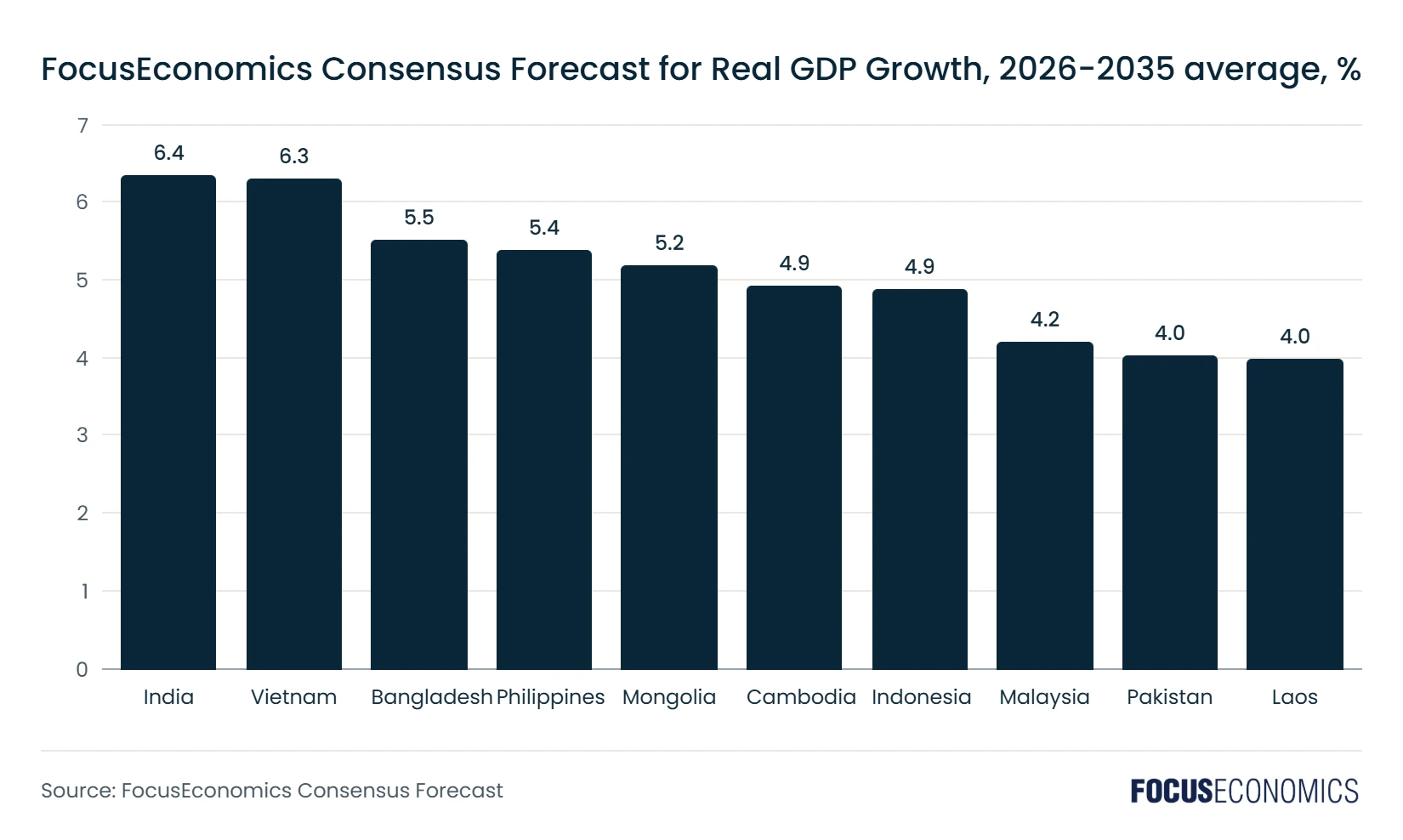
The Top 10 Fastest Growing Economies in Asia
1. India – 2026–2035 GDP growth Consensus Forecast: 6.4%
As well as being forecast as the continent’s best performer over the coming decade, India’s economy is also one of Asia’s most diverse. Services are the largest share of GDP, with IT services the crown jewel. Within manufacturing, chemicals, automobiles, steel and pharmaceuticals—especially generic drug production—are significant subsectors. Moreover, agriculture remains crucial for employment and rural livelihoods.
India is likely to remain among the world’s fastest-growing major economies over the coming decade. India’s GDP growth should be underpinned by a demographic dividend, rising household incomes, infrastructure investment and continued digitalization, while supply-chain diversification could support a larger manufacturing base. Services exports should remain another key engine. The main challenge is jobs. India needs to move tens of millions of workers from low-productivity agriculture and informal employment into factories and modern services. Social unrest could result if this fails to happen; the country got a taste of such unrest with recent “cockroach” youth protests.
2. Vietnam – 2026–2035 GDP growth Consensus Forecast: 6.3%
Vietnam has become a crucial part of Asian manufacturing supply chains in recent decades. Electronics, machinery, textiles, footwear and other manufactured products dominate exports, while foreign manufacturers continue to build production capacity in the country. Its extensive network of trade agreements, competitive industrial base and proximity to China have made Vietnam particularly attractive to companies pursuing manufacturing relocation as part of “China+1” supply-chain strategies.
Vietnam’s GDP growth in the coming decade will be supported by export-oriented manufacturing, foreign direct investment and continued integration into global supply chains. Electronics, machinery and other higher-value industries should gain importance as multinational firms diversify production within Asia. Rising incomes and urbanization will also support domestic demand. Over time, however, growth will depend increasingly on productivity gains rather than labor-cost advantages, given the country’s slow-growing and ageing population; these gains will be crucial to escape the middle income trap. Moreover, the country needs to develop more home-grown champions to complement foreign firms; the government is well aware, with recent structural reforms aiming to create a club of Korean-style elite “chaebol” firms.
3. Bangladesh – 2026–2035 GDP growth Consensus Forecast: 5.5%
Bangladesh has a huge industrial workforce and one of the world’s largest garment-export industries. Services already account for more than half of GDP, while industry contributes roughly one-third. Remittances provide another major source of foreign exchange and household purchasing power. The country enters the next decade from an uncomfortable position though: Bangladesh’ GDP growth has slowed sharply in the last couple of years, inflation has been high and serious weaknesses have emerged in the banking system. Moreover, most recently the country has suffered from energy shortages brought on by war in the Middle East.
Bangladesh has scope to sustain solid growth over the next decade, supported by manufacturing exports, remittances, infrastructure investment and a large labor force. Better transport links and port capacity, including the Matarbari Deep Sea Port once operational, could lower logistics costs and support export diversification beyond garments. However, the medium-term starting point is challenging. Weaknesses in the banking sector, low tax revenues, persistent inflation and subdued private investment are all likely to weigh on near-term activity. Sustained financial-sector reform and improvements in governance will be central to the outlook. Climate vulnerability, energy-import dependence and political uncertainty—including over constitutional reform implementation and the future of deposed leader Sheikh Hasina and her party—represent additional risks to long-term growth.
4. Philippines – 2026–2035 GDP growth Consensus Forecast: 5.4%
The Philippines has one of Southeast Asia’s most domestically driven economies. Services dominate activity, led by business-process outsourcing, finance, retail, transport and tourism, while electronics account for much of merchandise exports. Consumption is supported by a large, young population and substantial remittances. Public and private investment have also become important growth engines, despite softness in 2026 to date.
The Philippines’ GDP growth will be supported by favorable demographics, private consumption, remittances and a competitive services sector. Business-process outsourcing and digital services are likely to remain important, while infrastructure investment and deeper integration into regional supply chains could strengthen manufacturing and productivity. The main constraint will be the economy’s ability to raise investment and improve human capital. High electricity costs, infrastructure gaps and uneven education outcomes could limit potential growth. The country also remains highly exposed to natural disasters and imported energy prices, while rapid AI progress poses risks to the country’s IT sector.
5. Mongolia – 2026–2035 GDP growth Consensus Forecast: 5.2%
Mongolia’s economy is dominated by mining, especially coal, copper and gold, with China by far its most important export market. Expansion of the Oyu Tolgoi copper mine has boosted production and exports, while livestock agriculture remains important for rural livelihoods. The economy’s dependence on mining means that economic growth tends to fluctuate along with changes in commodity prices.
Mongolia’s GDP outlook will remain closely tied to the mining sector. Higher copper production, particularly from Oyu Tolgoi, alongside coal and other mineral exports should support investment, fiscal revenues and external earnings over the coming decade. Improved transport links with China could reduce export bottlenecks and reinforce mining-related growth. However, the economy will remain highly exposed to commodity cycles and Chinese demand. Stronger fiscal management will therefore be essential to limit procyclical spending and build buffers during periods of high mineral revenues. Diversification outside mining is likely to remain gradual, while governance weaknesses, a large current account deficit, inflation pressures and harsh climate conditions will continue to constrain stability.
6. Cambodia – 2026–2035 GDP growth Consensus Forecast: 4.9%
Cambodia’s GDP growth model is built around low-value export manufacturing, tourism, construction and real estate, alongside agriculture. Garments and footwear dominate merchandise exports, although production is expanding into bicycles, electronics and other light manufacturing. Foreign investment remains a major source of capital and employment. In the illicit economy, the cyber-scam industry is extremely large, with spillovers into formal parts of the economy such as real estate and gambling.
Over the coming decade, garments, tourism and construction will remain important, while foreign investment in electronics, automotive components and agribusiness could gradually raise manufacturing sophistication. Better logistics and regional trade integration should also support exports. However, weak productivity, skills shortages and a narrow domestic industrial base could slow the transition toward higher-value activity. Property-sector weakness and high household leverage remain important vulnerabilities.
7. Indonesia – 2026–2035 GDP growth Consensus Forecast: 4.9%
Indonesia is Southeast Asia’s largest and most diversified economy, with growth of roughly 5% in recent years driven mainly by domestic consumption. Services and manufacturing account for much of activity, while the country is also a major producer of coal, palm oil, nickel and copper. The government’s “downstreaming” strategy has encouraged processing of resources domestically, particularly nickel refining and battery manufacturing.
Indonesia’s economic growth will be supported by its large domestic market, favorable demographics, infrastructure investment and an expanding digital economy. Efforts to process minerals domestically could strengthen manufacturing and increase value added in sectors such as batteries and electric vehicles. Rising household incomes should also underpin consumption. However, faster potential growth will require stronger productivity, improved education outcomes and a more predictable business environment. Dependence on commodities remains a source of volatility, while protectionist policies—particularly regarding natural resources—could discourage investment and reduce efficiency.
8. Malaysia – 2026–2035 GDP growth Consensus Forecast: 4.2%
Malaysia has one of Asia’s most sophisticated manufacturing and export-oriented economies. Services account for most GDP, but manufacturing remains central to exports, particularly electronics, semiconductors, machinery, chemicals and medical products. Palm oil and hydrocarbons remain important, while recent investment has expanded semiconductor, cloud and data-center capacity.
Malaysia’s GDP outlook is supported by its established role in regional manufacturing, particularly semiconductors and electrical and electronic products. Investment in data centers, digital services and advanced manufacturing should help sustain growth over the coming decade, while rising wages will support domestic demand. Continued technology upgrading will be important as demographic trends become less favorable. Malaysia’s high degree of trade openness leaves it particularly exposed to global electronics cycles, weaker demand from China and greater trade fragmentation.
9. Pakistan – 2026–2035 GDP growth Consensus Forecast: 4.0%
Pakistan has a large but relatively inward-looking economy combining agriculture, manufacturing and services. Agriculture remains important for employment, while textiles and garments dominate exports. Services account for the largest share of Pakistan’ GDP, and remittances are crucial for foreign exchange and household incomes. After repeated balance-of-payments and inflation crises, the economy has recently stabilized under an IMF-supported reform program, although the recovery remains fragile.
Pakistan’s long-term outlook will depend heavily on whether recent macroeconomic stabilization is followed by sustained structural reform. The economy has considerable potential due to its large population, low urbanization and opportunities in textiles, information technology, agriculture, mining and renewable energy. However, high public debt, weak state-owned enterprises, low investment and recurring balance-of-payments pressures remain major constraints. Over the next decade, real GDP per capita growth is likely to be fairly low despite solid headline GDP growth, as a result of a booming population. Political uncertainty and policy reversals could continue to interrupt growth cycles, while climate change, water stress and rapid population growth will also place increasing pressure on infrastructure, food security and public finances.
10. Laos – 2026–2035 GDP growth Consensus Forecast: 4.0%
Laos has a small, resource-intensive economy centered on hydropower, mining and agriculture, with tourism, transport and manufacturing becoming increasingly important. Large dams make the country a significant electricity exporter, while mining generates substantial foreign exchange. The China-Laos railway has strengthened the country’s role as a transport corridor between China and Southeast Asia.
Laos has potential to benefit from deeper regional integration over the next decade, supported by hydropower exports, mining, tourism and improved transport connectivity. The China-Laos railway could strengthen the country’s role as a transit corridor linking China with mainland Southeast Asia and support trade-related investment. However, high public debt and large debt-service obligations will remain severe constraints on fiscal policy and public investment. Limited foreign-exchange reserves, low productivity and skills shortages further weaken Laos’ GDP outlook.