

South America goes west: In June, voters in both Colombia and Peru elected conservative, market-friendly presidents by razor-thin margins. Despite the two having similar policy platforms, our Consensus Forecasts – the average projection of our panel of the world’s leading economists – suggest that the ability of each new president to enact their agenda will differ notably in the Andes’ first- and second-largest economies by GDP.
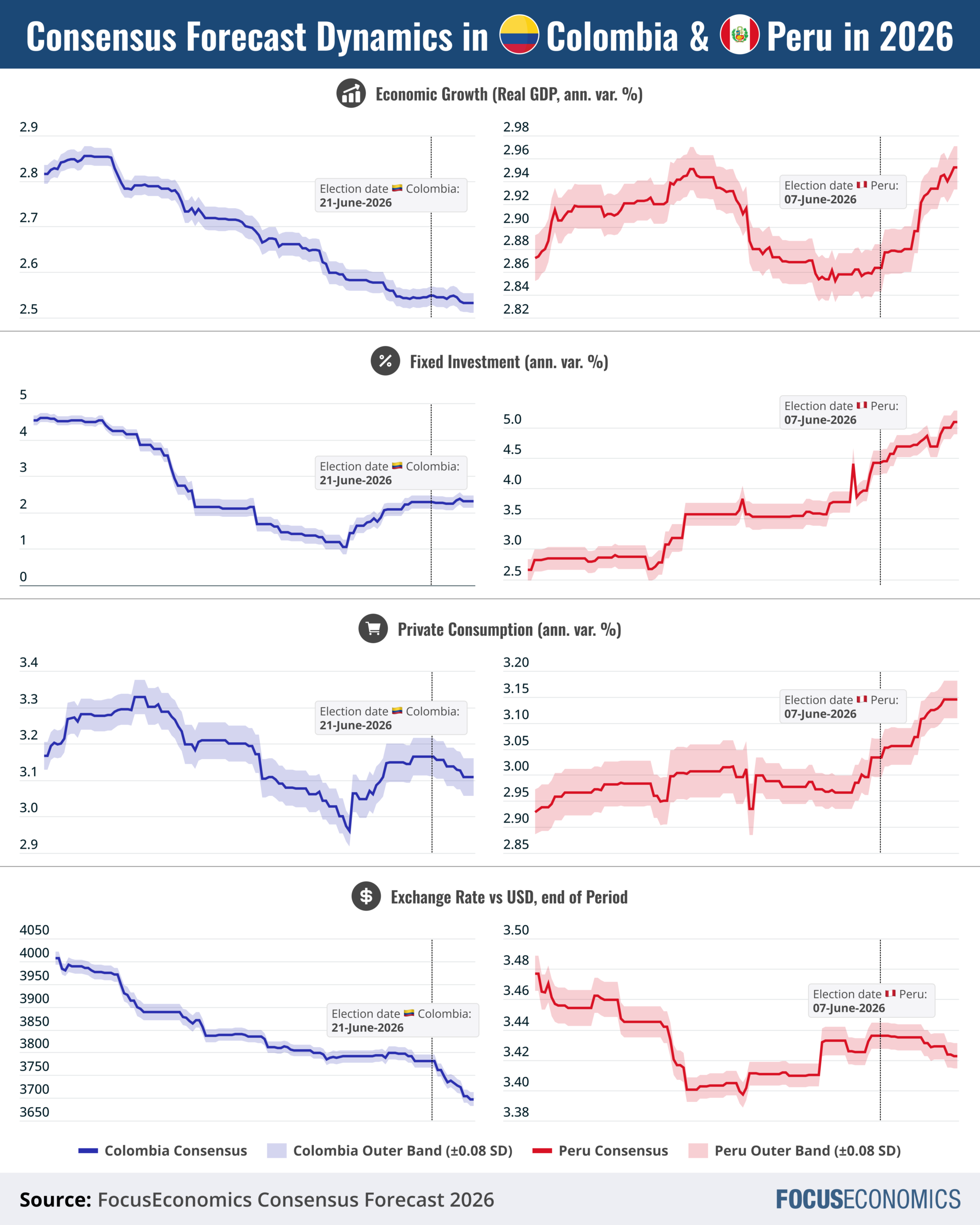
Peru Consensus shifts up: Our Consensus for Peru’s 2026 growth of GDP, private spending and fixed investment has climbed following the elections. The result was only recently confirmed after a closely contested vote, but Fujimori’s victory nonetheless is expected to support economic activity by preserving policy continuity, loosening financing conditions and reinforcing a market-friendly approach toward the country’s crucial mining sector, which accounts for about 10% of Peru’s GDP.
Colombia Consensus capped by political gridlock: In Colombia, the victory of the market-friendly De la Espriella generated a positive initial reaction in the markets. However, the response of our Consensus Forecasts has been considerably more restrained than in Peru. The main reason for this is that De la Espriella is widely expected to face significant legislative gridlock – with his own party lacking representation in Congress – limiting his administration’s ability to advance the reforms needed to address Colombia’s structural economic challenges. As a result, panelists have made only modest revisions to their GDP growth and domestic demand forecasts. The most notable adjustment has been to the 2026 exchange-rate outlook following the sharp appreciation of the Colombian peso in the aftermath of the election.
Insight from our panelists:
On the outlook for Peru’s economy, EIU analysts said:
“We expect that a Fujimori administration will be able to provide stronger and more stable leadership than her predecessors. Factors that are conducive to improved political stability include a much less fragmented Congress […]. The Iran war and its effect on global oil prices has raised inflationary pressure, with further downside risks in the event that the fragile peace does not hold. This will be partly offset by high demand and prices for copper and gold, as well as robust private consumption and resilient private investment amid easing credit conditions and hopes of an improved business environment under Ms Fujimori.”
Goldman Sachs’ Santiago Tellez commented on the new policy priorities in Colombia:
“We expect the incoming administration to prioritize three areas: public security, the healthcare sector, and the fiscal accounts, the latter being Colombia’s most salient macro vulnerability. Mr. De la Espriella has pledged a sizable, frontloaded fiscal adjustment of more than 3% of GDP, though specifics are likely to emerge only once the government transition is under way. The next administration will confront a polarized and fragmented Congress that will necessitate coalition-building.”
Our latest analysis:
Peru’s economic activity sped up ahead of the election.
Colombia’s central bank resumed its tightening cycle in late June.