

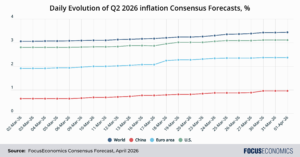
Continuous forecast hikes during March: Since the U.S. and Israel started bombing Iran on 28 February, our Consensus Forecasts for inflation for the vast majority of world economies have been hiked. Looking at the average global inflation projected for Q2 2026, our Consensus is now for a figure of 3.4%, up from 3.1% a month ago.
Euro area sees largest forecast increase amongst world’s top economies: Panelists have revised up their Q2 2026 inflation forecasts for the euro area by 0.5 percentage points, larger than the corresponding readings for China and the U.S. of 0.3 percentage points each. Unlike the U.S., the euro area isn’t a major energy producer and relies heavily on oil and gas imports. Moreover, the euro area’s transition to electric vehicles is less advanced than in China, leaving the former more vulnerable to higher prices at the pump. In addition, in China, limp domestic demand, fierce competitive pressures, carefully managed domestic refined oil prices and large petroleum stockpiles will further contain the pass-through of higher global energy prices to inflation.
More upgrades to come: As long as the conflict continues, further increases to our Consensus forecasts for inflation are likely. This is partly as more panelists incorporate the war into their forecasts, and partly as a prolonged conflict is likely to drive energy prices higher than they are currently. Zooming in on the U.S. gives an idea of where our forecasts could end up; the latest daily Consensus from 1 April is for U.S. inflation to average 3.1% in Q2. However, if we consider only panelists who have updated their forecasts since 15 March, that number rises to 3.3%.
Insight from our panelists:
On China, EIU analysts said:
“We view the impact on China to be smaller compared to other major economies, such as the US and Japan, given that imported hydrocarbons account for a very small share of the consumer price basket, and that domestic refined oil prices are carefully managed. Coal will become a substitute for electricity generation, heating and chemicals when oil and gas become less affordable. Market estimates also place China’s onshore crude stocks at 1.1bn-1.3bn barrels (or 110-140 days of import cover), indicating a high level of resilience against the disruptions from the ongoing war in the Middle East.”
On the latest Euro area data for March, ING’s Bert Colijn said:
“After a long period of eerily stable inflation despite global disruption, eurozone inflation has once again shot up thanks to the surge in energy prices. The price at the pump is the main culprit, with a litre of Euro-95 up almost 15% in the past month. The other main categories of inflation didn’t show an impact so far. Food inflation dropped from 2.5 to 2.4%, and core inflation fell from 2.4 to 2.3%. Both goods and services inflation moderated, indicating that price effects outside of energy were quite benign. But looking ahead, you cannot see the energy price increase in isolation. It’s all about the Middle East, which dominates the inflation outlook, and not just when it comes to energy prices, but also expect upside risk to food and goods prices given fertiliser shortages and broader supply chain problems stemming from the war. Businesses in the industry sector just increased their selling price expectations to the highest level since early 2023, for example.”
On the difference between the 2022 and 2026 energy-price shocks for the U.S, TD Economics’ Andrew Hencic said:
“The demand side of the equation is different. By 2022, successive waves of fiscal stimulus and lockdown measures had left households with large savings that were deployed as restrictions were lifted. That is no longer the case. The labour market is also not as tight as it was back then. By late 2021 and early 2022 the labour market was drum tight, with high levels of job switching and strong wage growth. Demand was outstripping supply for many goods. As a result, order backlogs were also plentiful, with businesses and consumer waiting for products. These circumstances created fertile conditions for firms to be able to pass on additional costs without fear of losing market share.”
Our latest analysis:
China’s PMI readings suggested the economy gained steam in March.
Mexico’s central bank cut rates in March.