

From RIGI to RIMI: In 2024, the Argentinian government approved the Incentive Regime for Large Investments (RIGI). The RIGI targets investments of at least USD 200 million in exchange for 30 years of stability in tax, customs, and foreign exchange rules, amongst other benefits. As of mid-May 2026, the government declared the RIGI had seen 14 projects approved worth USD 27 billion, with USD 100 billion in the pipeline. The energy and mining sectors have been key beneficiaries thus far. In 2026 the authorities went a step further by creating the RIMI, an investment incentive regime aimed at small- and medium-sized firms which pledge as little as USD 150,000 in initial capital.
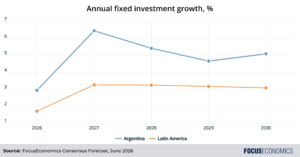
Investment growth to outpace region: Our panelists seem to expect some positive repercussions from the aforementioned investment schemes, along with steps the Milei government has taken to liberalize the labor market, lower barriers to trade and reduce FX distortions. From 2026 to 2030, Argentina’s investment growth is expected to outpace the Latin American average by two percentage points a year on average, as the chart below shows:
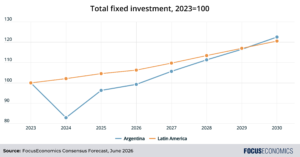
Total level of investment looks less impressive: However, when taking a longer view Argentina’s outperformance looks less substantial. Investment plunged by double digits in 2024 due to fiscal retrenchment and soaring inflation. As a result, from the start of Javier Milei’s first term in December 2023 to 2030 (towards the end of a hypothetical second term), fixed capital formation in the country will have only risen slightly more than the regional average.
2027 election results will be crucial: Whether Argentina consolidates a high-investment environment depends largely on the results of general elections scheduled for next year. A victory for Milei would likely be positive for investment, and a return to Peronism a negative, though businesses’ interest in exploiting the country’s vast energy and mining resources would likely remain whoever forms the next administration. Milei’s re-election chances hinge on whether: he can stem the recent tide of corruption allegations which have eroded his popularity; economic activity in labor-intensive sectors such as retail, construction and manufacturing picks up before the polls; and the leftwing opposition is able to rally around a popular candidate. In short, though Argentina has taken the first steps to boosting investment, the country’s volatile past should warn us against taking anything for granted.
Insight from our panelists:
On the impact of recent reforms on investment, EIU analysts said:
“Given that SMEs usually demand more labour than the large‑scale extractive and infrastructure projects covered by the RIGI, we expect that the RIMI will generate upside risks to employment. SME activity is concentrated in manufacturing, services and agro‑industry, where incremental capital expenditure tends to translate more directly into job creation. The government’s recent labour reform and the RIMI are lowering costs for SMEs to invest and hire. As a result, we believe that expansion in formal employment, particularly outside the capital‑intensive energy and mining sectors, will pick up over the forecast period. The government has also decreed an extension of the RIGI for another year to July 2027, as it has been successful at stimulating large‑scale investment in Argentina’s most competitive sectors. What is novel in the decree is the incorporation of onshore upstream oil and gas projects. Under the new rules, these projects will need to invest a minimum of US$600m instead of the US$200m for other projects.”
On the RIGI, Goldman Sachs analysts said:
“RIGI (the incentive regime for large investments in Argentina) has emerged as the legislative push needed to accelerate the development of major projects in the country, and we got the sense there is a lot of momentum behind it across most of the stakeholders we met with in Buenos Aires. Unlike a decree, RIGI is a federal law, and many provinces are aligning with it. This alignment ensures stability on taxes and royalties at federal and provincial levels, from the date of implementation. Major resource-rich provinces in Argentina support RIGI.”
Our latest analysis:
Australia’s economy performed worse than expected in Q1.
Swiss GDP growth accelerated in Q1.