

In our latest special report, we examined the panorama for the regional economy for the remainder of this decade and beyond, highlighting areas such as the future shift in SSA’s center of economic gravity and the significant panelist forecast divergence within and between countries. Below are some key insights.
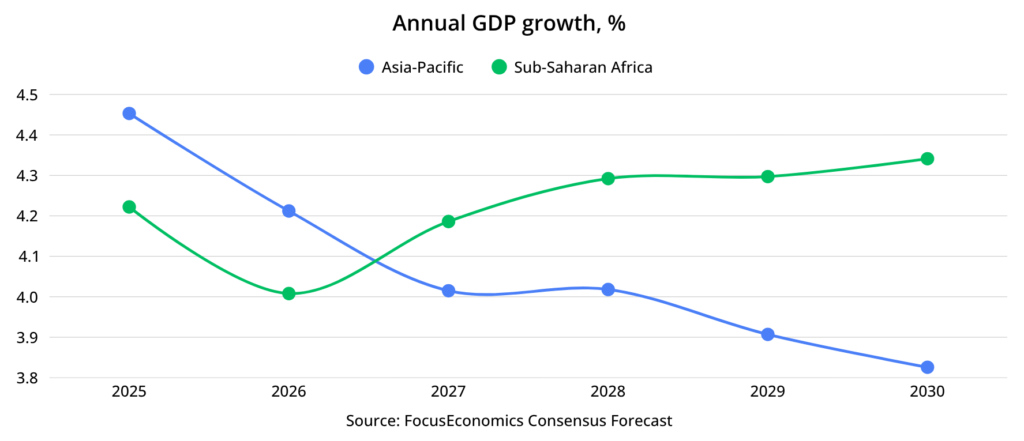
Sub-Saharan Africa to become world’s fastest-growing region from 2027: Asia-Pacific has long been the quickest-expanding part of the world, but SSA will occupy that place from next year onward. Growth will be underpinned by 2%+ per annum population growth, digital transformation, sustained investments in mining, energy and infrastructure, and deepening intra-African trade under the AfCFTA.
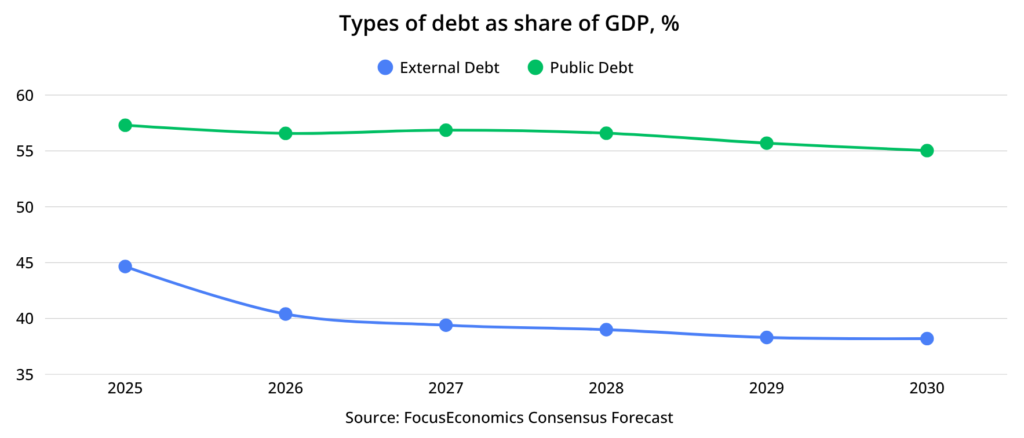
Public and external debt burdens to fall: Though several countries will continue to experience fiscal difficulties, on an aggregate level our panelists expect public and external debt in SSA to trend down in coming years. This comes after multiple government debt defaults in the region in recent years.
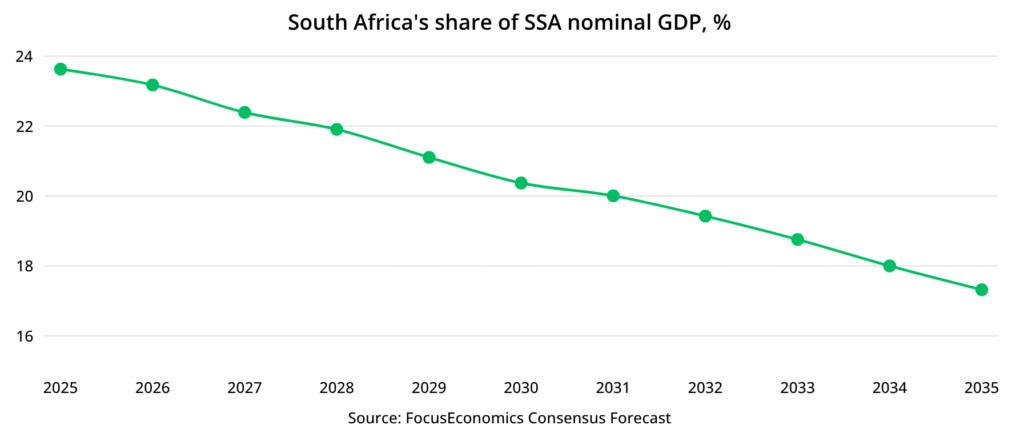
Center of gravity to shift: South Africa, which has long been SSA’s most industrialized economy, will see its relative importance wane as its GDP growth will be the region’s weakest. In contrast, poorer but faster-growing economies like Ethiopia and Nigeria will see their share of nominal GDP rise in the coming years.
Insight from our panelists:
On South Africa, Oxford Economics analysts said:
“Lofty administered prices, persistently high unemployment, relatively tight monetary policy, and the prospect of higher price inflation constrain both consumers’ ability and willingness to spend. Stronger private-sector participation in South Africa’s network industries (such as energy, telecommunications, transport, and water provision) is needed to boost competitiveness, achieve energy security, finance the green transition, create employment opportunities, and reduce poverty and inequality.”
African Development Bank analysts commented on ongoing regional debt risks despite a declining debt ratio:
“The declining debt-to-GDP ratio reflects a rebound in economic growth and fiscal consolidation undertaken in several countries. Nevertheless, vulnerabilities remain due to the changing structure of public debt. This shift has driven up debt service costs, which further constrains fiscal space and crowds out government spending on key social services and infrastructure projects. The share of government revenue devoted to external debt service increased from 23.7 percent in 2017 to 31 percent in 2024.”
Our latest analysis:
Hong Kong’s economy disappointed in Q2.
Canada’s economy performed well in May.