

In November 2008, visiting the London School of Economics, Queen Elizabeth II asked the question everyone else was too polite to put plainly: why had nobody seen it coming? The eventual written reply blamed a failure of the collective imagination.
The tempting conclusion might’ve been that economic models are worthless. British economist Joan Robinson put the better lesson crisply: a model accounting for every variation of reality would be no more useful than a map at a scale of one to one. Models are deliberate distortions, and the question is not whether they are false—all of them are to a degree—but which falsehoods matter, and when.
Where Economic Models Break Down
Classical and Neoclassical Theory
Classical economics begins with a powerful idea: decentralized markets can coordinate millions of decisions without central direction, as in Smith’s famous idea of the “invisible hand”. Neoclassical economics sharpened that logic. Consumers maximize utility, firms maximize profits, and prices adjust until supply equals demand. Workers are paid according to productivity, and capital flows towards uses offering the best return.
These ideas remain embedded in almost every introductory economics course because they explain an enormous amount. Raise the price of strawberries and consumers tend to buy fewer strawberries. Increase wages in a particular occupation and, over time, more people are likely to train for it. If one manufacturer can produce the same component more cheaply than another, production tends to migrate towards the more efficient firm.
However, real markets are full of power imbalances. A worker negotiating with the only major employer in a small town is not participating in the same kind of market as a programmer choosing between ten competing technology firms. A tenant searching for a flat next week has less bargaining power than a landlord who can wait three months. A pharmaceutical company with a patent does not face the competitive pressure assumed in a textbook market containing hundreds of interchangeable sellers.
Information is also uneven. Buyers may not know whether a second-hand car is reliable. Patients cannot easily judge whether a medical treatment is necessary. Investors can misunderstand opaque financial products. Firms often know more about their products, risks and costs than customers or regulators do.
Then there is behavior itself. Neoclassical models often assume individuals respond consistently to prices and incentives—in other words, that they have rational expectations. Humans do respond to incentives, but not always with the precision the models imply. People procrastinate, follow crowds, fear losses more than equivalent gains and sometimes sacrifice income for fairness, identity or habit. A consumer may stay with an expensive bank for years because switching is irritating. A worker may reject a higher-paying job because it requires moving away from family.
Growth theory provides another example. The Solow model, one of the central neoclassical models, shows how capital accumulation, population growth and technological progress interact. It explains why simply adding machines cannot generate permanently accelerating growth: diminishing returns eventually set in.
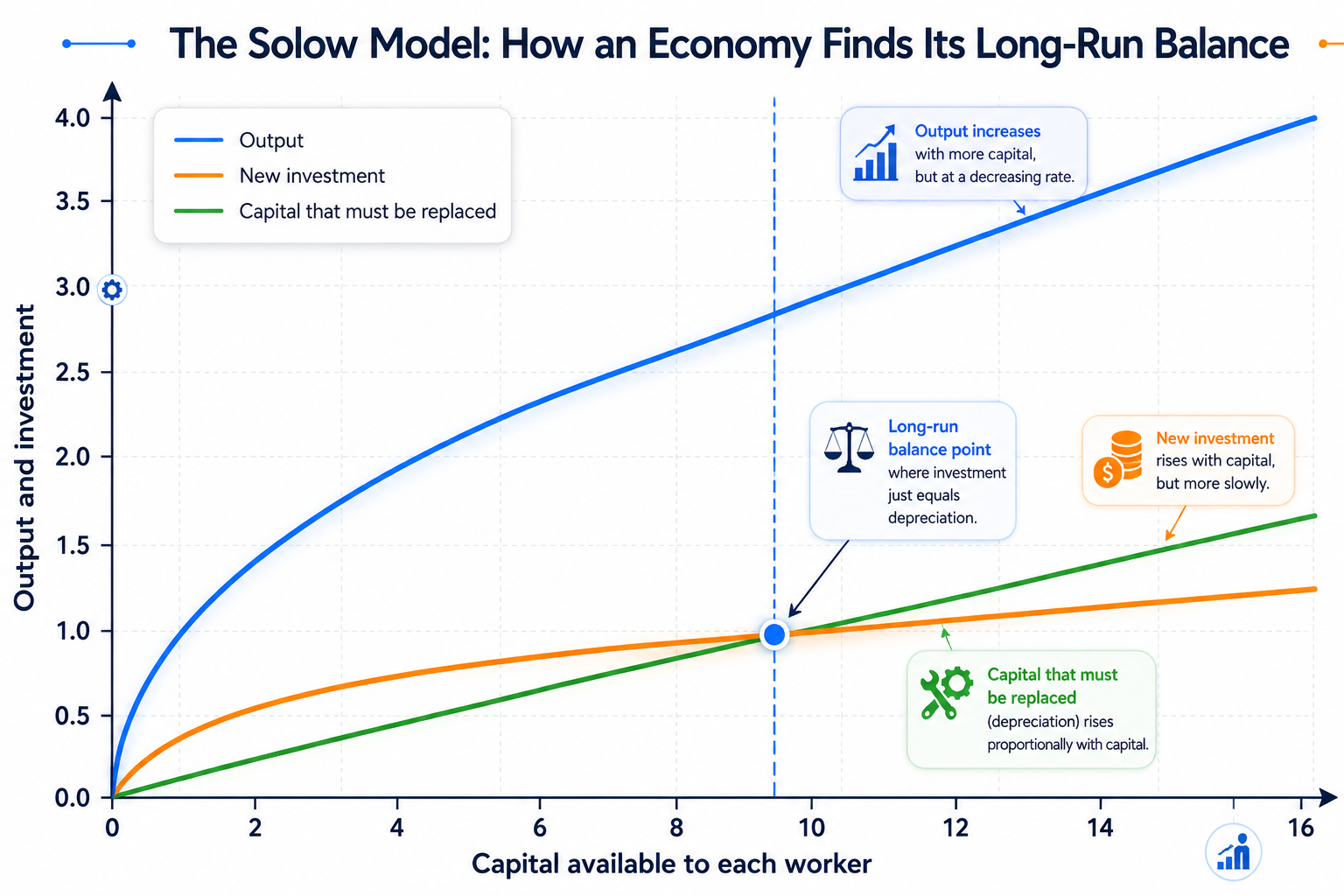
But technology—the key driver of improvements in total factor productivity—appears largely from outside the model. The mechanism responsible for sustained long-run increases in living standards is treated as exogenous. That is a considerable omission. Governments and firms spend vast sums on education, research, infrastructure and intellectual property precisely because technological progress is not manna falling from the economic heavens.
Neoclassical theory is therefore strongest when competitive pressures are meaningful, prices can adjust and institutions are reasonably stable. It becomes less reliable when monopoly, information gaps, financial instability, political bargaining or behavioral quirks dominate the outcome.
Keynesian Economics and the IS-LM Model: Demand, Multipliers and Expectations
Keynesian economics—which has its origins during the Great Depression of the 1930s—begins from a weakness in classical theory: economies do not always heal themselves quickly. If households suddenly cut spending and firms stop investing, total demand can collapse. Businesses then reduce production and dismiss workers. Those unemployed workers spend less, weakening demand further. An economy can become trapped below its productive capacity for months or years.
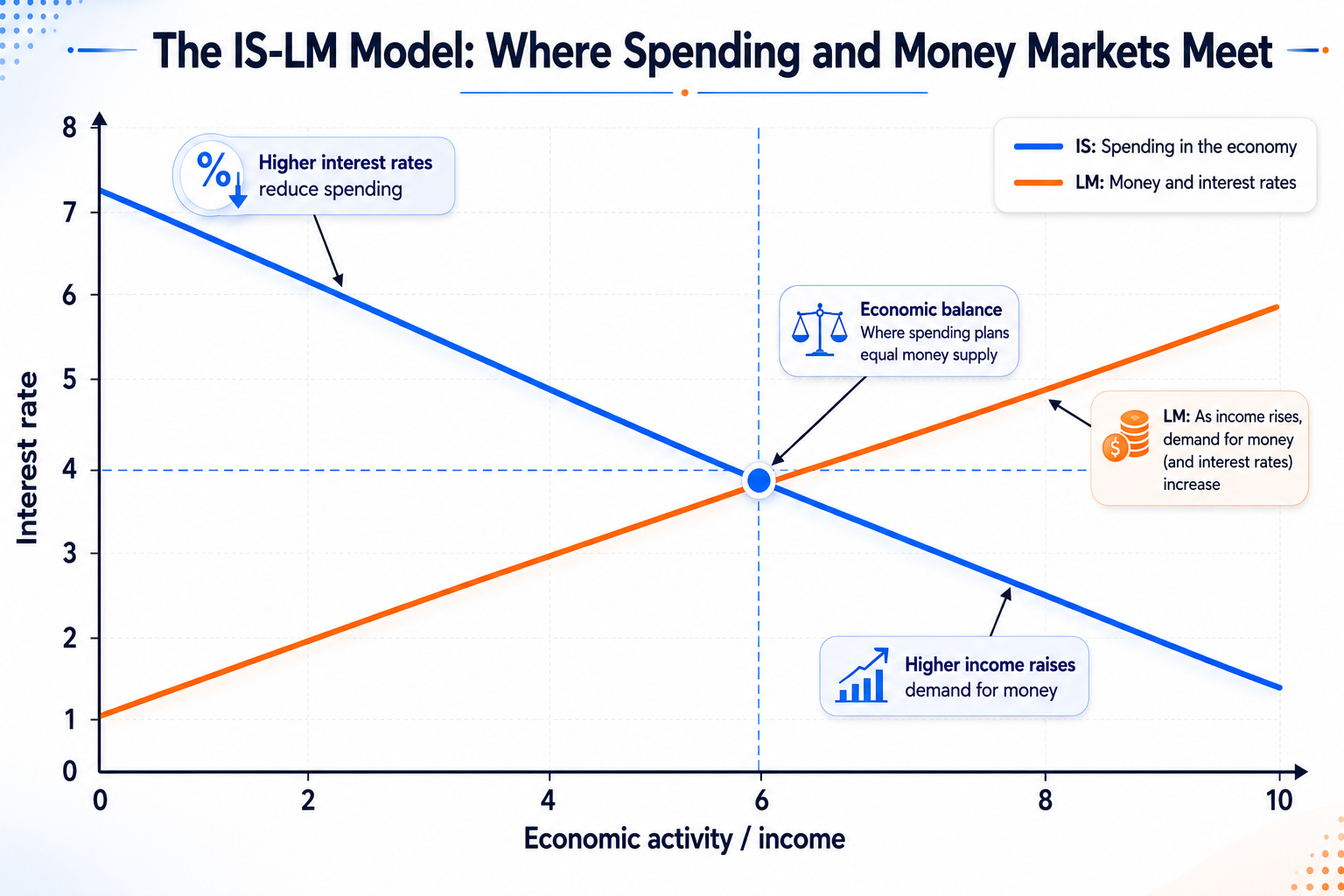
This insight became especially important during deep recessions. It also produced one of macroeconomics’ most famous diagrams: the IS-LM model. The model reduces an entire economy to two interacting markets. The IS curve represents equilibrium in the goods market, connecting interest rates with levels of output. The LM curve represents equilibrium in the money market. Their intersection gives a combination of national income and interest rates at which both markets balance.
Its appeal is obvious. Fiscal policy shifts the IS curve. Monetary policy shifts the LM curve. Suddenly a complicated national economy can be analyzed on a single sheet of paper. That said, the financial system is reduced almost beyond recognition. Banks, bond markets, credit risk, collateral, leverage and asset prices barely appear. Yet in modern economies these mechanisms often determine whether lower interest rates actually stimulate spending.
Suppose a central bank cuts its policy rate during a banking crisis. IS-LM suggests cheaper money should encourage borrowing and investment and smooth the downturn in the economic cycle. But what if banks are trying to repair damaged balance sheets and refuse to lend? What if firms are already drowning in debt? What if households fear unemployment and would rather repay mortgages than buy cars?
Expectations present another problem. A government announcing higher spending today may stimulate demand. But consumers and firms also care about what they think taxes, inflation and interest rates will look like tomorrow. Two policies that appear identical inside a simple Keynesian model can produce different outcomes if expectations differ.
Inflation complicates matters further. Early Keynesian analysis focused heavily on demand and unemployment. The stagflation of the 1970s—high inflation combined with weak growth—showed that supply shocks could disrupt the simple relationship between demand and prices. An oil shock can simultaneously raise production costs and reduce output. Stimulating demand may then support employment while worsening inflation.
Modern macroeconomics has built much richer models to address some of these problems, such as Dynamic Stochastic Equilibrium (DSGE) models. But the old Keynesian lesson survives: aggregate demand can matter enormously, particularly when an economy has unused capacity.
The IS-LM model is best understood not as a forecasting machine but as a teaching device. It forces the analyst to ask how monetary and fiscal policy interact. It becomes dangerous only when its clean curves are mistaken for the tangled plumbing of an actual financial system.
Keynesian economics—which has its origins during the Great Depression of the 1930s—begins from a weakness in classical theory: economies do not always heal themselves quickly. If households suddenly cut spending and firms stop investing, total demand can collapse. Businesses then reduce production and dismiss workers. Those unemployed workers spend less, weakening demand further. An economy can become trapped below its productive capacity for months or years.
This insight became especially important during deep recessions. It also produced one of macroeconomics’ most famous diagrams: the IS-LM model. The model reduces an entire economy to two interacting markets. The IS curve represents equilibrium in the goods market, connecting interest rates with levels of output. The LM curve represents equilibrium in the money market. Their intersection gives a combination of national income and interest rates at which both markets balance.
Its appeal is obvious. Fiscal policy shifts the IS curve. Monetary policy shifts the LM curve. Suddenly a complicated national economy can be analyzed on a single sheet of paper. That said, the financial system is reduced almost beyond recognition. Banks, bond markets, credit risk, collateral, leverage and asset prices barely appear. Yet in modern economies these mechanisms often determine whether lower interest rates actually stimulate spending.
Suppose a central bank cuts its policy rate during a banking crisis. IS-LM suggests cheaper money should encourage borrowing and investment and smooth the downturn in the economic cycle. But what if banks are trying to repair damaged balance sheets and refuse to lend? What if firms are already drowning in debt? What if households fear unemployment and would rather repay mortgages than buy cars?
Expectations present another problem. A government announcing higher spending today may stimulate demand. But consumers and firms also care about what they think taxes, inflation and interest rates will look like tomorrow. Two policies that appear identical inside a simple Keynesian model can produce different outcomes if expectations differ.
Inflation complicates matters further. Early Keynesian analysis focused heavily on demand and unemployment. The stagflation of the 1970s—high inflation combined with weak growth—showed that supply shocks could disrupt the simple relationship between demand and prices. An oil shock can simultaneously raise production costs and reduce output. Stimulating demand may then support employment while worsening inflation.
Modern macroeconomics has built much richer models to address some of these problems, such as Dynamic Stochastic Equilibrium (DSGE) models. But the old Keynesian lesson survives: aggregate demand can matter enormously, particularly when an economy has unused capacity.
The IS-LM model is best understood not as a forecasting machine but as a teaching device. It forces the analyst to ask how monetary and fiscal policy interact. It becomes dangerous only when its clean curves are mistaken for the tangled plumbing of an actual financial system.
Monetarism: When Money Stops Being a Reliable Guide to Prices
Monetarism, which grew in prominence in the 1960s and 1970s, restored money to the center of macroeconomics. Its most famous proposition is simple: sustained inflation ultimately requires excessive growth in the money supply relative to the economy’s capacity to produce goods and services. If vastly more money chases roughly the same amount of output, prices tend to rise.
This was an important corrective to theories that treated monetary conditions as secondary. It also pushed policymakers to take central-bank credibility seriously. Persistent inflation cannot simply be blamed on greedy firms, wage demands or temporary shortages if monetary policy repeatedly accommodates rising prices.
But controlling “the money supply” is harder than the phrase suggests. Put simply, which money should we focus on? Economists distinguish between narrow measures such as physical currency and bank reserves and broader measures that include bank deposits and other liquid assets. These aggregates do not always move together. Financial innovation can also change how much spending a given quantity of measured money supports.
Velocity—the speed at which money circulates—creates another difficulty. A simple monetary relationship links the quantity of money, its velocity, the price level and real output. If velocity were stable, controlling the money supply would provide a relatively predictable path for nominal spending.
But velocity can change sharply. During financial panic, households and firms may hoard liquid assets. Banks may accumulate reserves. Money can expand without generating an equivalent surge in consumer spending. At other times credit can grow rapidly even when traditional monetary aggregates appear restrained.
Central banks therefore discovered that hitting monetary-growth targets was often harder than monetarist theory implied. Many eventually shifted towards targeting short-term interest rates and, later, explicit inflation objectives.
Monetarism also struggles when used to explain short-run price movements mechanically. A drought can raise food prices. An embargo can raise energy prices. A pandemic can disrupt supply chains. These events can generate bursts of inflation without being caused initially by excessive money growth.
The crucial question is what happens next. If monetary policy accommodates repeated price increases and allows expectations to adjust upward, temporary inflation can become persistent. In this sense monetarism remains useful as a warning about the monetary conditions that allow inflation to endure, even if it is less effective as a month-to-month forecasting rule.
Comparative Advantage: The Gains from Trade and Who Captures Them
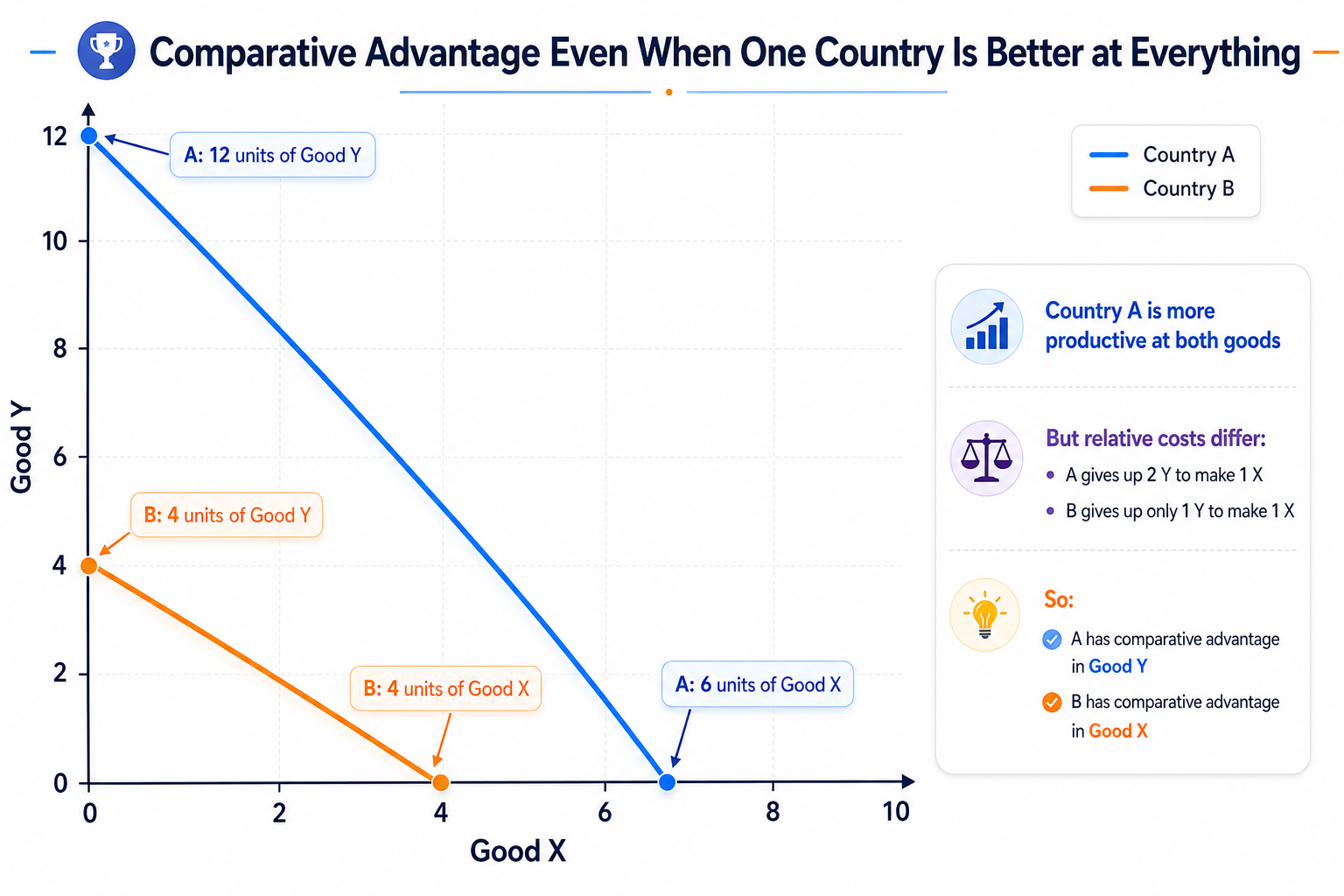
Few economic models are simultaneously as powerful and as misunderstood as comparative advantage. The principle is often summarized badly as “countries should produce what they are best at”. That is not quite right. A country can benefit from trade even if it is worse at producing everything. What matters is opportunity cost.
Imagine Country A can produce either 100 tons of wheat or 50 machines with a given amount of labor. Country B can produce either 60 tons of wheat or 10 machines. Country A is more productive in both industries. Yet producing one machine costs Country A two tons of wheat, while it costs Country B six tons. Country A therefore has a comparative advantage in machines; Country B has a comparative advantage in wheat.
If each specializes more heavily according to those relative costs and then trades, total production can rise. Both countries can potentially consume more than they could in isolation. The word “potentially” is key here. Comparative advantage shows that trade can increase the size of the overall economic pie, but does not guarantee that every individual receives a larger slice.
Suppose a rich country opens itself to imports of labor-intensive manufactured goods. Consumers gain because clothes, furniture and electronics become cheaper. Exporters may gain because foreign markets expand. Owners of capital may gain as firms reorganize production internationally.
However, workers competing directly with imports may lose. A factory closing in one region creates losses that are concentrated and visible. The gains from cheaper imports are distributed thinly across millions of consumers. A household might save a few hundred euros a year through lower prices without ever noticing. A machinist who loses a €40,000 salary notices immediately. This is exactly what has happened in North America and Europe in the last few decades, as firms have outsourced much industrial production—particularly to China.
Adjustment is also slower than simple trade models imply. Workers cannot transform instantly from textile employees into software engineers. Skills are specific. Homes cannot always be sold easily. Families have roots. New industries may appear hundreds of kilometers away from the old ones. Trade can therefore increase national income while worsening outcomes for particular sectors, towns or generations of workers.
Politics enters precisely at this point. If governments use some of the gains from trade to finance retraining, mobility, infrastructure or income support, the distributional damage can be softened. If adjustment is left entirely to displaced workers, opposition to trade should surprise nobody.
Comparative advantage remains one of economics’ strongest demonstrations of why exchange can create wealth. However, efficiency and distribution are different questions; a country can gain from trade while some of its citizens lose badly.
Limits Every Economic Model Shares
Most economic models share several deeper limitations. The first is simplification. Models deliberately exclude variables. There is no alternative. A model containing every household, firm, regulation, belief, transaction and technological possibility would cease to be a model. It would be the economy itself.
The useful question is therefore not whether assumptions are unrealistic. All models contain unrealistic assumptions. The question is whether the omitted factors are important for the problem being studied. For instance, assuming that airline passengers weigh the same might be harmless when estimating ticket demand. It would be disastrous when calculating aircraft loading.
Second, parameters change. Economists often estimate relationships from historical data: how much consumers reduce spending when interest rates rise, how quickly wages respond to unemployment, how investment reacts to tax changes. These relationships are not physical constants. Institutions evolve. Technology changes. Regulations shift. People learn. A relationship estimated from the 1990s may not survive the arrival of smartphones, online banking, remote work or algorithmic pricing.
Third, people respond to policy itself—also known as the Lucas Critique. If a government adopts a predictable rule, households and firms may change behavior in anticipation. A model built from past relationships can then become unreliable precisely because policymakers begin using it.
Fourth, economic data are imperfect. GDP is revised. Employment surveys contain sampling error. Inflation measures require judgements about changing product quality. Informal economic activity can escape measurement, and policymakers often make decisions using data that will look different six months later.
Finally, models tend to handle measurable variables better than institutional ones. Interest rates fit neatly into equations, but things like trust, political legitimacy, social cohesion, corruption, organizational competence or fear do not. Yet these can determine whether identical policies produce radically different results in different countries.
Where Economic Models Still Earn Their Place
Despite their limitations, models are still incredibly important to understanding how the economy works. For one, they force assumptions into the open. If someone claims that a tax cut will increase investment, a model asks how strongly firms respond to the after-tax return on capital. If a government claims tariffs will create jobs, a trade model asks what happens to input costs, consumer prices, exports and retaliation. If a central bank raises interest rates to control inflation, a macroeconomic model forces analysts to trace the effect through borrowing, spending, employment and prices.
Models are also valuable for counterfactuals. Policymakers observe what happened, but rarely what would have happened under another policy. A recession may follow an interest-rate increase, yet the relevant question is whether inflation would have been worse without it. Trade liberalization may coincide with factory closures, but some firms might have closed anyway because of automation.
Models are particularly useful when treated as a collection rather than a single doctrine. A policymaker examining inflation might begin with a monetarist question about nominal spending, add a Keynesian analysis of demand, inspect supply constraints and then consider expectations and labor-market behavior. Each model illuminates part of the mechanism.
The economy is too complicated to fit inside any single equation. That does not make equations useless; it simply means economists should remember which parts of the world they erased before they started calculating.